Author: Andrea Golindano

  • How Your Corporate Gifting Program Strengthens the Relationships That Matter

    How Your Corporate Gifting Program Strengthens the Relationships That Matter

    Appreciating Employees and Clients with Well-Planned Corporate Gifts

    Businesses use well-planned corporate gift programs to give meaningful gifts to employees, customers and leads. It’s a way to celebrate an employee’s work anniversary, say thanks for a job well done or strengthen company-wide morale. Corporate gifting to clients shows appreciation for long and lasting relationships, indicates how much their business is valued and improves the chances the relationship will continue in the future.

    The best corporate gift is thoughtful and unique. Companies are stepping up from the welcomed but soon forgotten gift basket to develop corporate gift giving programs with more creativity and thoughtfulness with gifts that are remembered. The industry is forecast to grow at an annual average rate of 8% and hit $306 billion in 2024 according to a 2021 report by Coresight Research.

    Why Corporate Giving Programs Matter

    Large or small, businesses grow by building strong relationships, both in the office and with clients. A well-thought-out corporate gifting program makes it easy to let the people who matter know how important they are.

    Companies that deploy planned employee gift programs throughout the year build a loyal and committed workforce. A recent Gallup/Workman survey found that employees at companies that recognized their contributions though giving programs were 56% less likely to look for a new job and 73% felt less burned-out from the job.

    With strategic client gift programs, businesses are able to build on successful relationships and enhance their reputations with their customers. They’re also very effective for helping a business grow. According to a Knack Shops gifting report, 83% of businesses surveyed believe that business gifts generate measurable, positive ROI.

    Strategies for Your Corporate Gift Giving Program

    Approach developing your gift giving programs as you would most marketing plans: determine your audience, define your goal, set a budget, select gifts and devise your distribution channels. Here are five important things to take into consideration when you set out to develop your plan:

    1. Don’t look at the gift you’re giving as a sales tool. It’s not about making a splashy first impression. Corporate gift giving is about making a deep lasting impression. Be tactful with your use of your company’s brand and make the message heartfelt.
    2. If it feels like your gift giving program is ‘been there, done that,’ perhaps it’s time to think outside the box, or, in the case of kitted employee and client gift ideas, think inside the box with a selection of gifts you can include in unique corporate gift boxes.
    3. Give personalized or branded white label products that are manufactured and personalized with your business’s name, logo and brand message.  Custom variable printing and on-demand printing allows companies to prepare and send corporate gifts for any occasion at any time.
    4. Marketing.com can help you create a corporate gift storefront that allows your employees and clients to select the gift they want from a preselected variety of branded gifts. We’ll also manage gift packaging and shipping
    5. Don’t forget to take shipping materials and gift weight into consideration when making your corporate gift selection. These factors play a role in determining your shipping rates and options.

    Find a Gifting Program Partner

    As companies recognize the value of a good corporate gifting strategy and realize the impact gift giving can make on employee morale and client retention, they’re turning for guidance from companies like Marketing.com. According to the 2021 Coresight Research report, 52% of respondents outsourced some or all of their corporate gifting needs. The percentage is likely to increase because experienced outside vendors can help alleviate challenges.

    Using a full-service commercial printing or gifting service streamlines corporate gifting from concept through delivery. This includes proposals, gift design and packaging design. Most will also provide curating and fulfillment services to make your gifting program run smoothly all year long. These companies can provide guidance on issues like gifting frequency and spending. They can also keep your company aware of emerging gifting occasions, such as corporate gifting to support Diversity, Equity and Inclusion (DEI) programs that urge diverse representation and participation in the workplace from historically underrepresented groups. 

    Conclusion

    In today’s remote business world, an effective corporate gifting program should be just as much a priority for marketing and enhancing a company’s reputation as a strong social, digital or print marketing program. Factors like ROI, increased productivity and business growth are important. The difference is impact. Saying thanks and recognizing the importance of employees and clients generates good will that can’t always be measured.

  • Why Your Business Should Target Millennials With Direct Mail

    Why Your Business Should Target Millennials With Direct Mail

    Over the past 40 years, the only thing declared dead more than direct mail is the fictional film character Michael Myers from the Halloween horror movie series. This is especially true in an age when digital marketing through emails was supposed to push direct mail into the dustbins of time. But like the hard-to-kill horror movie antagonist, the rumors of its demise continue to be premature.

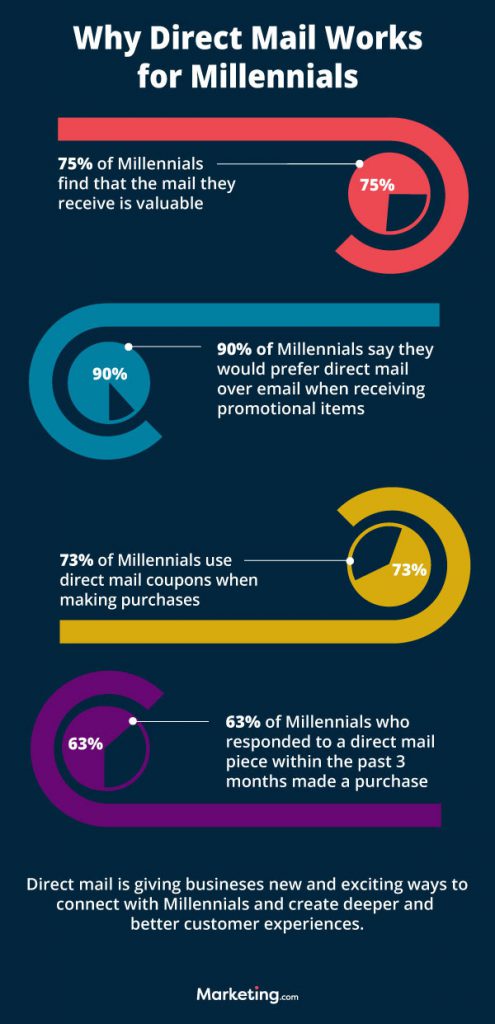
    This is especially true with the audience that is the most digitally connected generation in history – Millennials. We’re talking about an age group that seems to spend all their waking hours living on their phones – checking email and social messaging and sharing digital content. On the surface, devoting direct mail campaigns to this demographic of consumers would be a waste of money and time. However, nothing could be further from the truth. According to the USPS, nearly 90% of Millennials enjoy receiving and reading direct mail content. The same study reported that 57% of Millennials receiving direct mail act on the offers presented to them.  

    Why Direct Mail Works for Millennials

     There are several reasons that direct mail resonates so strongly with Millennials. The fact that direct mail comes only once a day makes it special. Millennials report enjoying going to their mailbox to see what exciting offer has come their way. According to MarketingCharts, 90% of Millennials think direct mail advertising is reliable and 75% of Millennials say that direct mail provides a sense of exclusiveness. In addition, direct mail gives them a greater sense of security as opposed to emails where personal data can be at risk.

    For businesses, other reasons make direct mail an exciting and profitable way to connect with this age group:

    • Limited competition.  According to email receiving statistics, the average person receives over 100 emails per day. Compare that to the two direct mail pieces per day received by the average American household. Direct mail gives marketers the ability to stand out from the competition because there is less competition.
    • Direct mail gets read. The same USPS study referenced above also indicates that 88% of the mail recipients of the Millennial generation read through direct mail pieces. And not only that, but they spend more time reading mail (9.7 minutes) than Generation Z (7.9 minutes) and Baby Boomer generations (8 minutes). That’s a remarkable statistic when compared to the average of 10-15 seconds spent reading an email.
    • More room for the message.  The average smartphone screen is 6.3 inches. The USPS has increased the maximum size for mailing First-Class mail postcards from 4 ¼” x 6” to 6” x 9”. That gives postcards sent by direct mail more room to engage the audience with headlines, call-to-actions, images, and digital elements like QR codes. An email with the same elements would appear cluttered and be difficult to read.
    • Direct mail sticks around.  A 2019 study by Go Inspire Group revealed that the average direct mail piece has a shelf life of approximately 17 days. Direct mail spends more time sitting around where consumers can access and take advantage of offers longer than any other marketing medium. This gives Millennials more time to act on offers or calls to actions.

    Ways to Make Direct Mail for Millennials More Effective

    When developing direct mail campaigns targeting Millennials, there are several factors to keep in mind:

    • Keep the messaging short.   Over the last 20 years, according to Mailing Systems Technology, direct mail copy has decreased by 62%. This indicates a growing understanding that to be effective, pieces must become more scannable, use widely understood icons and design elements, incorporate digital response elements in call-to-actions and use white space more effectively.
    • Mix Direct Mail and Digital Response.  Use digital response links in direct mail content to send recipients to product or service videos or special offers on a website. Mailing pieces can contain a digital coupon that can be scanned at brick-and-mortar stores. Combining digital and direct mail efforts can lead to 40% conversion rates according to the USPS. 
    • Use Direct Mail Retargeting.  Businesses are seeing great results with Direct Mail Retargeting. It involves sending a personalized direct mail piece to a recent website visitor who abandoned a shopping cart or left the website before completing an action. Messaging can be highly personalized and offer incentives like coupons while enhancing brand value and creating a deeper connection with consumers.

    Direct mail is giving businesses new and exciting ways to connect with Millennials and create deeper and better customer experiences. When used alone, or in tandem with other digital media, it can enhance brand recognition, establish trust or increase sales. Direct mail is proving to be a winner with Millennials.

    Marketing.com is your go-to omnichannel partner for engaging your audience and building your brand with the incorporation of Direct Mail  – contact us today!

  • Maximizing the Marketing Mix: How to Maximize Performance Across Channels

    Maximizing the Marketing Mix: How to Maximize Performance Across Channels

    The world is more connected now than it has ever been.  With the internet and mobile technology becoming increasingly integrated into our daily lives, there have never been more channels through which to reach consumers.  But with so many channels, it has also never been more of a balancing act.  It can seem like a real challenge to home in on which channels are best and how much to allocate to them, but a holistic understanding of your marketing strategy can yield enormous results.  The right combination of channels, as well as cooperation between those channels, is the key to your success.

    Cross-channel marketing is the strategic integration of your various channels into a seamless experience that increases customer exposure to your brand and guides them towards purchases.  Which channels you choose to emphasize in your strategy will require a lot of important data, but it will yield more data in return.  Consider the demographics of your target audience: age, gender, devices, income, occupation, and interests are all going to play a factor in which channels to target more aggressively.  For example, since Edison reports that 95% of Baby Boomers say they use email to communicate in their personal lives, you may engage this demographic through email from a home computer. On the other hand, it might be wiser to target Millennials through their mobile devices. This group may be more enticed by social media engagement and app-based experiences.  To cater through the improper platform would be to bark up the wrong tree.

    Through studying reported data to measure important KPIs, you should gain a more comprehensive understanding of your customers’ journey through your various platforms and portals.  Pay mind to how and why a customer may have reached any given stage of their purchase.  Were they brought here by an email promotion?  Search engine results?  Social media link? Are they a returning customer?  A registered member of your platform?  Did they abandon a full cart at any moment in the sales funnel, and could they be remarketed to?  The answers to these questions are powerful tools that will help you optimize your next moves.  By consolidating these data into customer relationship management tools, marketing calendars, and buyer personas, you can study changes and trends in the engagement patterns of your customers.

    As you attune your strategy to the data you have acquired, the advantages of cross-channel marketing should become clearer.  You now have the means to more sharply focus your approach through personalized marketing methods while increasing brand exposure through seamless cross-platform customer experiences. This mean optimizing SEO, increasing social engagement, adding display advertising, developing print and mailing campaigns and using promotions to increase brand awareness.  Targeted advertisements, email listings, paid placements on search engines, and social media posts should all lead a customer towards a purchase, but these all work more effectively when they are operating in a coordinated, interlinked system.  For example, you can follow up an online transaction with a thank you email and an invitation to a newsletter, or target deals to previous customers based on their past buying history and engagements across your platforms.  These linked channels not only create greater exposure, but also  form a concise pathway to a purchase.  Greater visibility creates more opportunities for a customer to engage with a brand, gradually funneling them towards a point of sale.   These separate points all work in harmony making the process more effective at converting audiences, streamlining transactions, increasing sales, and improving customer satisfaction.

    The benefits of diversifying and refining your marketing strategy should be an enticing enough proposition on its own tactical merit, but recent data gives concrete proof that more connected engagement pays dividends.  The average consumer today experiences triple the marketing touchpoints before purchasing than it did 20 years ago.  Brands using more channels have higher purchase rates.  Strong cross-channel engagement is creating more returning customers. The tools of marketing are rapidly evolving, and companies that apply those tools well are proving their explosive potential.  To ignore the data is to leave money on the table.  Applying strategic SEO that improves results rankings on search engines makes it easier for your company be found by someone conducting an organic search. By adding a social media presence, blog, or email campaign, you could be substantially widening the scope of your influence and converting more visitors into purchasers.  Experiment, see what works, and adjust accordingly.  It may take time to see results from your efforts in one channel, but expanding your outreach can still yield valuable insights in the short term while the rest of your plan plays out.

  • How AR is Transforming Customer Experiences for Brands

    How AR is Transforming Customer Experiences for Brands

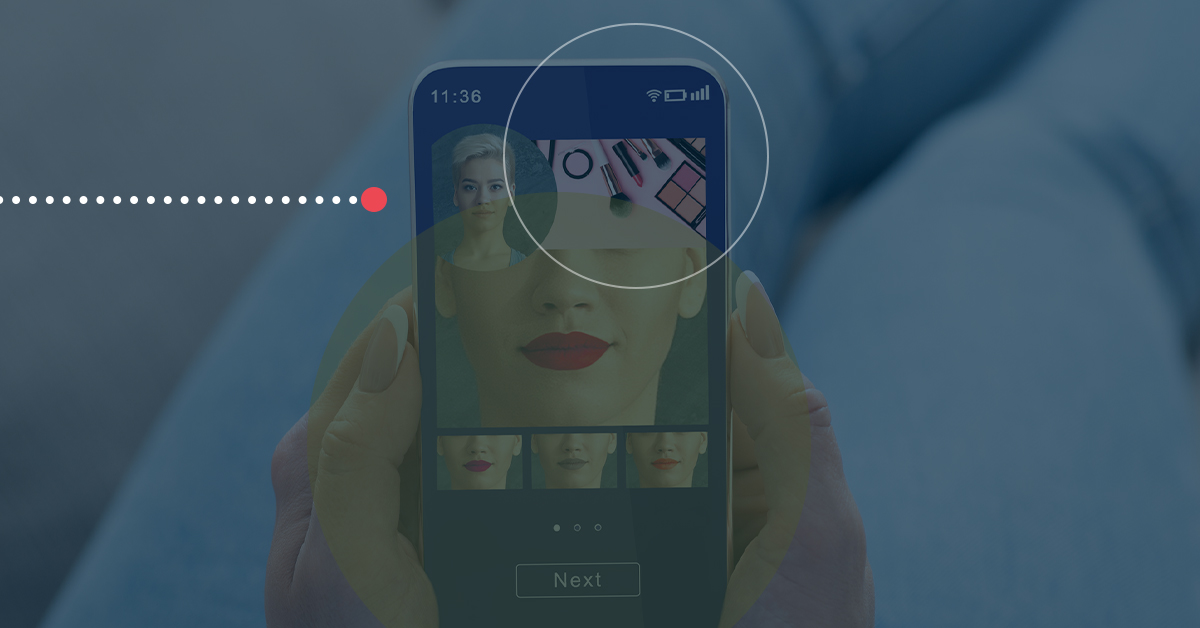
    Marketing and promotion are always changing. It’s inherent to the process. In our ever-evolving business landscape, marketing strategies must keep up with the fluid and dynamic needs of rapidly changing consumer preferences. Augmented reality (AR) is being used in new ways to take traditional print marketing methods and turn them into interactive, immersive, and unforgettable experiences that keep users engaged. Printed direct mail campaigns that incorporate AR have seen response rates jumping from 2-3% to 35%. Today, most consumers are not intrigued by an ordinary postcard that feels impersonal and generic but when AR is tied to the printed media, interest soars.

    According to TechTarget, “Augmented Reality (AR) is the integration of digital information with the user’s environment in real-time …AR users experience a real-world environment with generated perceptual information overlaid on top of it.” With AR, we can explore new ways to spread brand awareness and engage customers in ways heretofore unimagined.  AR allows users to overlay virtual interfaces and experiences onto the world we live in, merging the real world with accessible technology that many of us already own and use frequently. “AR delivers visual elements, sound and other sensory information to the user through a device like a smartphone or glasses,” elaborated TechTarget.

    A large part of what makes AR such a valuable marketing tool is its accessibility. The vast majority of us own and rely on a smartphone for much of our daily activity, and the rapid evolution of mobile technology has given us access to increasingly more sophisticated portable computing, camera features, and Internet connectivity. Considering that 83.37% of the world’s population owns a smartphone, opportunities abound for businesses to bring AR into their marketing strategies and take what would have otherwise been a low-performing print campaign to the next level with AR.

    In its early stages, AR saw implementations through the likes of filters and lenses on Snapchat, simple graphical overlays used to enhance user-generated images. Further developments in the field led to experiences such as Pokémon GO, encouraging an explosive burst of users to explore their neighborhoods on foot in pursuit of fantastical creatures in familiar environments. From these two examples alone, we can see how AR has gone from surface-level curiosities to immersive, interactive experiences for users, bridging the gap between realms by transforming how we interact with brands and their content. It’s exciting to note that even the United States Postal Service will be offering special discounts through an AR campaign that will have customers scanning QR codes on its signature blue mailboxes around the country leading into the holiday season.

    AR’s Impact on Consumer Purchases

    AR is already having a dramatic impact on how we shop and make decisions. Everyone has had the experience of purchasing something through an online vendor, only for it to show up and be not quite right – a garment may not look or fit as advertised, or a piece of furniture or décor may not suit a space as originally anticipated. AR tools dramatically increase customer satisfaction by increasing the perceived tangibility of products before they have even been added to the cart. Manipulable 3D models transcend the limitations of static images by allowing customers to preview and place their purchases in real space, making them more informed on how they spend their money. In this way, AR is already proving itself as a tool that makes for clearer brand communication and customer satisfaction, so it’s a win-win situation for all parties.

    AR Takes Us Into a New Frontier for Immersive Experiences

    AR is even impacting long-running institutions that we may otherwise consider resistant to change. The United States Postal Service is incorporating AR elements into new types of postage and incentivizing its usage through discounts, further ushering in the technology while passing savings on to customers. This further serves to demonstrate that new technological developments, instead of pushing established media into obsolescence, can bring our existing services into the modern age while helping to prop up and reinforce the analog communications we still rely on to this day. A lot can be accomplished with a QR code or other scannable iconography, showing that this technology has its place in our world as a replacement for older methods, or working alongside them to create something more effective.

    All these developments sound thrilling, but how effective it can be is a moot point without the ability to feel its tangible effects. Like with most technological offerings, though, there are concrete figures to be tracked that point directly to the impact of AR’s marketing potential. As is the case with various social media platforms, impressions can be logged.  Interactions, opens/scans, captures, shares, unique users, dwell time, and conversions into actual purchases are all readily available and will tell you exactly what sort of impact your AR implementation is having on your business. Restaurants, car companies, and even large media corporations are actively implementing AR experiences into their marketing and figuring the above metrics into their future strategies.  And the data is promising: MG Motor has recorded 4,600 engaged hours in reaction to their 3D displays, ViacomCBS saw a 29% sales lift from a recent AR campaign, and scannable menus are already a staple of our current landscape. And as we know, knowledge is power. These tools are already changing how we do business and providing numbers for further improvements.

    AR is the way things look to be going, and it’s not going away any time soon. In our increasingly digital landscape, we must arm ourselves with all the tools and metrics available to us. AR affords businesses the unique opportunity to add tangibility to the physical while expanding upon the physical with digital experiences. It’s an ever-growing marketing opportunity and a genuinely exciting resource that businesses across all industries should be taking advantage of. Especially when considering the pace at which technology evolves and is implemented, one would be at great risk of being left behind by not immediately considering ways in which AR can extend its reach.

    Marketing.com is your go-to omnichannel partner for engaging your audience and building your brand with the incorporation of AR – contact us today!