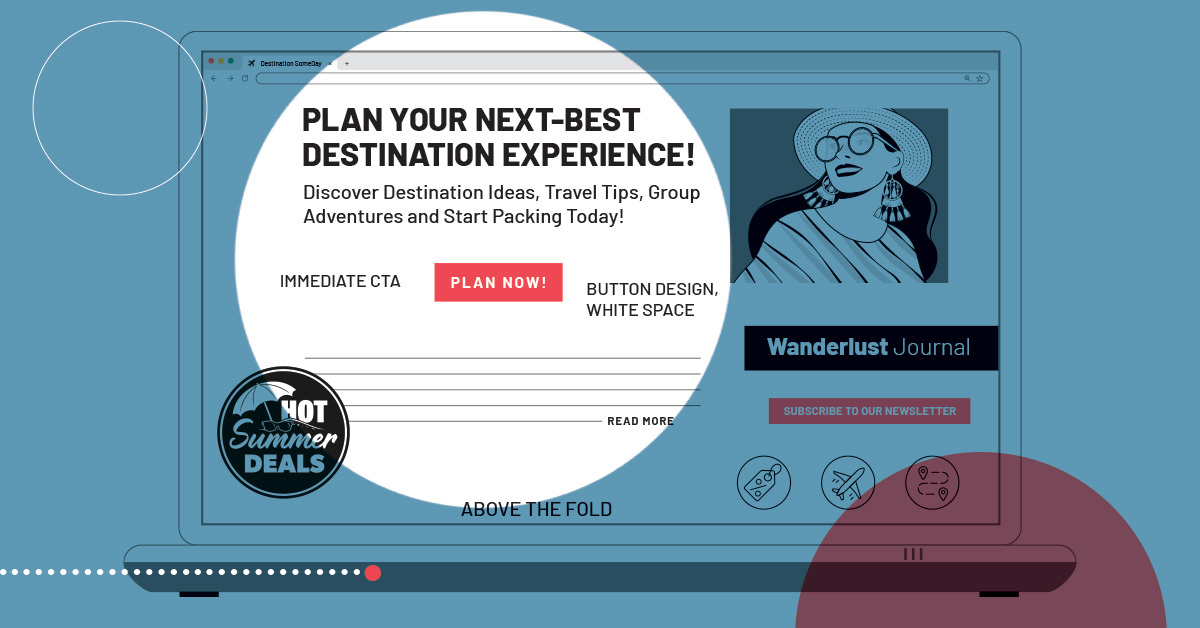
Crafting the perfect Call to Action (CTA) isn’t easy, but it can be the difference between a good marketing campaign and a great one. A clearly defined and perfectly timed CTA can provide the crucial nudge your audience needs to take the action you desire. Whether you want them to make a purchase, sign up for a newsletter, or download a resource, your CTA must clearly define the action you wish your audience to take.
In this in-depth post, we’ll do a deep dive into the anatomy of a killer CTA, covering placement, timing, what makes a good promotional offer, how to design your CTA to convert, and more. We’ll also highlight common mistakes marketers make when designing CTAs, with examples of CTAs you can use to improve the effectiveness of your campaigns and even some examples of famous CTA fails for a masterclass in what not to do when designing promotional offers. Let’s get into it!

Let’s Start with Placement
The placement of your CTA is critical. It needs to be easily seen by the user. When placed where users naturally look or scroll, it’s more likely to catch their attention. Your CTA should align with the user’s journey through the content and be placed at points where users have received enough information to decide. Strategic placement increases engagement, and CTA’s placed above the fold or at the end of compelling content tend to perform better, especially when the CTA tells the user what step you want them to take next. Your CTA should naturally fit within the context of the content. For example, the “Buy Now” button might be best placed after a product description, while the “Learn More” button would be more effective after an intro paragraph. Here are some examples of common CTA placements, tips, and common mistakes to avoid.
Above The Fold
Often, users miss your CTA or fail to see it due to poor placement. Ensuring your primary CTA is visible without scrolling is crucial. The term “above the fold” originates from newspapers but has been adapted for web design. It refers to the part of a webpage that is visible without scrolling. This is prime real estate for your most essential CTAs because it immediately captures the user’s attention. For instance, a “Sign Up Now” button on a landing page should be placed prominently so visitors see it as soon as they arrive.
Why it Matters
- CTAs placed above the fold can improve conversion rates by 10-15%.
- For B2C websites, this could mean conversion rates of around 3-5%, while B2B websites might see around 2-4%.
Common Mistakes to Avoid:
- Cluttered Design: Placing too many elements around the CTA can distract users.
- Lack of Contrast: It may be overlooked if the CTA doesn’t stand out visually.

End of Content
Placing CTAs at the end of blog posts, articles, and videos can be highly effective. By the time readers or viewers reach the end of your content, they have consumed valuable information and are more likely to take action. For example, at the end of a blog post about email marketing tips, you might include a CTA for a free email marketing guide.
Why It Matters:
- End-of-content CTAs can see a 20-30% conversion rate increase when strategically placed.
- B2C end-of-content CTAs might convert at 1-2%, while B2B could be around 1-1.5%.
Common Mistakes:
- Weak Placement: The CTA will not be seen if the content isn’t engaging enough to keep users until the end.
- Non-compelling Offers: If the offer isn’t enticing enough, users won’t take action despite reading the content.

Pop-Ups and Slide-Ins
While pop-ups and slide-ins can be intrusive if overused, they can capture attention effectively when used sparingly and strategically. A well-timed pop-up offering a discount code just as a user is about to leave the site can convert potential lost leads into customers. Slide-ins, which appear less abruptly, can provide additional CTAs without disrupting the user experience.
Why It Matters:
- Exit-intent pop-ups can capture 10-15% of visitors abandoning the site.
- Pop-ups generally have a conversion rate of 3-5%.
Common Mistakes:
- Overuse: Excessive use of pop-ups can annoy users and lead to higher bounce rates.
- Irrelevant Offers: Pop-ups that don’t align with user intent can be seen as spammy.

Sidebars and Banners
Sidebars and banners are ideal for secondary CTAs or ongoing promotions. A sidebar on a blog could feature a “Subscribe to Our Newsletter” CTA, while a banner at the top of the page could announce a limited-time sale. These placements keep CTAs visible without overshadowing the main content.
Why it Matters:
- Sidebars typically have a lower conversion rate, around 0.5-1% for B2C and 0.3-0.6% for B2B.
- Banners can convert at around 0.5-1.5%.
Common Mistakes:
- Ignoring Mobile Users: Sidebars may not be as practical on mobile devices, where they are often hidden.
- Banner Blindness: Users often ignore banner ads, so making them too subtle can reduce effectiveness.

Now that we’ve got a better handle on where your CTAs should be placed let’s discuss the equally important topic of timing.
 Timing Your CTA
Timing your CTAs correctly is crucial for maximizing conversions. Depending on the urgency of your offer, the value you deliver, or whether you’re trying to re-capture someone who is about to leave your site before converting, timing can play a crucial role in the success of your offer. Sometimes, you might want to immediately engage with a time-sensitive offer or wait until you’ve provided enough value before making the ask.
Immediate Engagement
Using CTAs early in the user journey can be particularly effective for urgent offers or time-sensitive actions. For instance, during a flash sale, a “Shop Now” button placed prominently at the top of the homepage ensures that users are immediately aware of the offer.
Why It Matters:
- Immediate CTAs can see a conversion rate increase of up to 15%.
- For B2C, this could mean rates of 3-5%, and B2B around 2-4%.
Common Mistakes:
- Premature Asking: Asking for too much too soon can turn users away. Ensure the CTA matches the user’s stage in the journey.
- Lack of Context: CTAs without context or value proposition early on can confuse users.
After Building Value
Placing CTAs after providing valuable information increases the likelihood of conversion. When users feel they have gained something from your content, they are more inclined to take the next step. For example, after an informative video tutorial, a CTA to download a related eBook can feel like a natural progression.
Why It Matters:
- Value-building CTAs can boost conversions by 20-30%.
- Conversion rates might be around 2-4% for B2C and 1-3% for B2B.
Common Mistakes:
- Delayed CTAs: Waiting too long after delivering value can lead to missed opportunities.
- Weak Follow-Up: CTAs that don’t build on the provided value may not resonate with users.
Exit-Intent Pop-Ups
Exit-intent pop-ups detect when a user is about to leave your site and present a final offer or reminder. This could be a discount code, a special offer, or a reminder to subscribe to your newsletter. These pop-ups are a last-chance effort to retain the visitor and can significantly improve conversion rates.
Why It Matters:
- Exit-intent pop-ups can recover 10-15% of abandoning visitors.
- They generally convert at 2-4%.
Common Mistakes:
- Overwhelming Offers: Too many or too aggressive offers can frustrate users.
- Poor Timing: The user might have left if the pop-up appears too late.
Now that placement and timing are out of the way, let’s dive into the most challenging part of crafting a compelling CTA: the message you want to communicate and how best to encourage action.
 Crafting Your CTA’s Message
The wording of your CTA is crucial for driving action. Often, CTAs lack clear and concise language or use passive language that doesn’t encourage action. To write a compelling CTA, keep these things in mind:
Make Sure Your CTA is Clear and Concise
Your CTA should use straightforward language that tells the user precisely what to do. Ambiguity can lead to confusion and lower conversion rates. Phrases like “Download Now,” “Sign Up Today,” or “Get Your Free Trial” leave no room for doubt about the desired action.
Why It Matters
- Clear CTAs can increase conversion rates by 20-30%.
- B2C clear CTAs convert at around 3-6%, B2B at 2-5%.
Common Mistakes:
- Ambiguity: Vague language can confuse users about what action to take.
- Jargon: Using industry-specific language can alienate some users.
Action-Oriented
Starting your CTA with strong verbs encourages action. Words like “Download,” “Sign Up,” “Get Started,” and “Join” are powerful motivators. They provide clear directives that prompt immediate responses from your audience.
Why It Matters:
- Action-oriented CTAs can see conversion rate increases of up to 20%.
- B2C might see 3-5%, B2B around 2-4%.
Common Mistakes:
- Weak Verbs: Using weak verbs like “Click Here” instead of action-oriented verbs can reduce urgency.
- Too Many Words: Overly long CTAs can dilute the message and reduce effectiveness.
Urgency and Scarcity
Creating a sense of urgency or scarcity can prompt users to act quickly. Phrases like “Limited Time Offer,” “Only a Few Left,” or “Ends Soon” tap into the fear of missing out (FOMO), which can be a powerful motivator for immediate action.
Why It Matters:
- Urgency/scarcity CTAs can improve conversions by 30-40%.
- Conversion rates for B2C can be around 4-6%, B2B around 3-5%.
Common Mistakes:
- False Urgency: Misleading users with fake urgency can damage trust.
- Overuse: Constantly using urgency can lead to user fatigue and reduced effectiveness.
Use Direct and Action-Oriented Language
Action Verbs:
- Start your CTA with a strong action verb that tells users exactly what to do. Examples include “Download,” “Sign Up,” “Register,” “Get Started,” “Join,” “Buy,” “Subscribe,” “Claim,” “Read,” or “Learn More.”
Specificity:
- Be specific about what the user will get by taking action. Instead of a vague “Click Here,” use “Download Your Free E-Book,” “Subscribe to Our Newsletter,” or “Start Your Free Trial.”
Keep It Short and Simple
Brevity:
- Limit your CTA to a few words. The ideal length is usually between two to five words. Examples include “Shop Now,” “Get Offer,” “Join Now,” “See Plans,” or “Contact Us.”
Clarity:
- Avoid jargon or complex language. Ensure that anyone can understand what the CTA means at a glance.
Focus on Benefits
Highlight Value:
- Make it clear what the user will gain by clicking the CTA. For example, “Get 20% Off,” “Try for Free,” or “Join Our Community” emphasize the benefit to the user.
Solve a Problem:
- Address a specific need or problem your audience has. For example, “Find Your Perfect Fit,” “Boost Your Productivity,” or “Secure Your Spot.”
Make the Next Step Obvious
Next Steps:
- Clearly indicate what will happen after the user clicks. For example, “Sign Up for Free,” “Download Now,” or “Get Instant Access” make it clear what the user should expect.
Consistency:
- Ensure that the CTA aligns with the user’s expectations set by the preceding content. If your content is about an e-book, the CTA should directly relate to downloading that e-book.
Avoid These Pitfalls
Too Many Words:
- Long, complicated CTAs can overwhelm users. Stick to simple, direct instructions.
Vague Language:
- Avoid generic phrases like “Click Here” or “Learn More.” Be specific about what the user will get or do.
Misleading Information:
- Ensure your CTA accurately represents what happens next. If users feel misled, it can damage trust and reduce conversions.
Inconsistent Messaging:
- The CTA should align with the surrounding content. For example, if the content discusses an e-book, the CTA should be related to downloading the e-book.
Examples of Clear and Concise CTAs
- E-commerce: “Add to Cart Now” vs. “Add to Cart”
- SaaS: “Start Your Free Trial” vs. “Try It Free”
- Content Download: “Download Free Guide” vs. “Get Your Free Guide”
- Newsletter Signup: “Join Our Mailing List” vs. “Subscribe for Updates”
By implementing these strategies, you can create CTAs that are clear, concise, and compelling, driving higher engagement and conversion rates.
 Promotional Offers
Promotional offers can significantly enhance the appeal of your CTAs. Below are some effective strategies.
Discounts and Coupons
Offering discounts and coupons is a tried-and-true method to incentivize action. A CTA like “Get 20% Off Your First Order!” provides immediate value and encourages users to make a purchase.
Stats:
- Discounts can boost conversion rates by 20-40%.
- B2C discounts convert at around 4-6%, B2B around 3-5%.
Common Mistakes:
- Over-Discounting: Frequent or large discounts can devalue your product.
- Hidden Terms: Not clearly stating the terms and conditions can lead to customer dissatisfaction.
Free Trials and Samples
Allowing users to try your product or service before committing can build trust and reduce hesitation. A CTA such as “Try It Free for 30 Days!” invites users to experience the benefits without financial risk.
Stats:
- Free trials can improve conversion rates by 15-25%.
- Conversion rates for B2C can be around 3-5%, B2B around 2-4%.
Common Mistakes:
- Complex Signup: Making the process to access the free trial too complicated can deter users.
- Lack of Follow-Up: Not following up with trial users to convert them to paid users can result in lost opportunities.
Exclusive Content
Providing access to exclusive content can entice users to take action. A CTA like “Access Our Free E-Book Now!” offers value in exchange for their engagement, such as an email signup or social share.
Stats:
- Exclusive content CTAs can boost conversions by 20-30%.
- B2C conversion rates might be around 3-5%, B2B around 2-4%.
Common Mistakes:
- Low Value: Offering content that isn’t valuable enough to users can lead to low engagement.
- Not Mobile-Friendly: If the content isn’t accessible on mobile devices, it can limit conversions.
Example CTAs
Here are some example CTAs tailored to different industries:
E-commerce
- “Add to Cart Now and Enjoy Free Shipping!”: This CTA highlights a common incentive in e-commerce and encourages immediate action.
- “Limited Time Offer: Buy Now and Save 20%!”: Urgency combined with a discount can drive quick conversions.
SaaS
- “Start Your Free Trial Today – No Credit Card Required!”: Removing the credit card requirement lowers the barrier to entry.
- “Get Started Now and Unlock Premium Features!”: Encourages users to take advantage of additional benefits.
Content Download
- “Download Our Free Guide to Digital Marketing!”: Provides immediate value to the user.
- “Get Your Free E-Book on Effective Email Campaigns!”: Targets a specific interest with valuable content.
Newsletter Signup
- “Join Our Mailing List for Exclusive Updates and Offers!”: Emphasizes exclusivity and benefits.
- “Subscribe Now and Get Weekly Tips Straight to Your Inbox!”: Highlights the frequency and value of the content.
Bundled Deals
Bundling products or services can create a compelling offer. A CTA like “Buy One, Get One Free!” provides added value and can increase the perceived worth of the offer.
Stats:
- Bundled deals can improve conversion rates by 25-35%.
- B2C might see 4-6%, B2B around 3-5%.
Common Mistakes:
- Confusing Bundles: Complicated bundle deals can confuse users and reduce conversions.
- Not Highlighting Savings: Failing to communicate the deal’s value clearly can make it less attractive.
A common mistake people make when designing their CTAs is the actual design of the buttons and where the CTAs are placed relative to other visual elements on the page. Poor design can lead to users simply not seeing them even when strategically placed. The key is to design for visibility, from contrast to size and placement.
Design for Visibility
 The design of your CTA plays a critical role in attracting clicks and conversions. Use contrasting colors to make your CTA stand out from the rest of the page. The button should be eye-catching and easily distinguishable from other elements. It should also be large enough to click easily, especially on mobile devices, and placed in a prominent location where users can easily find it.
Button Design
The design of your CTA button plays a critical role in its effectiveness. Use contrasting colors to make the button stand out from the rest of the page. The button should be large enough to be easily clickable but not so large that it feels out of place.
Why It Matters
- Well-designed buttons can increase conversion rates by 10-20%.
- B2C conversion rates can be around 3-5%, B2B around 2-4%.
Common Mistakes:
- Poor Contrast: Buttons that don’t stand out visually can be missed.
- Unclear Text: Button text that’s hard to read reduces effectiveness.
Whitespace
Surrounding your CTA with sufficient whitespace ensures it doesn’t get lost in the clutter. Whitespace draws attention to the CTA and makes it easier for users to focus on the desired action.
Why It Matters:
- Proper use of whitespace can improve conversions by 15-20%.
- B2C conversion rates can be around 3-5%, B2B around 2-4%.
Common Mistakes:
- Overcrowded Layout: Cluttered designs make it hard for users to focus on the CTA.
- Lack of Visual Hierarchy: Not establishing a clear visual path to the CTA can reduce its impact.
Icons and Graphics
Enhancing CTAs with relevant visuals can increase engagement. Icons and graphics can draw the eye and help users quickly understand the action you want them to take. For example, a download button might include a small arrow icon to reinforce the action.
Stats:
- CTAs with visuals can boost conversions by 20-25%.
- B2C might see 3-5%, B2B around 2-4%.
Common Mistakes:
- Irrelevant Graphics: Using visuals that don’t align with the CTA can confuse users.
- Overuse: Too many visuals can make the CTA look cluttered and reduce effectiveness.
Test, Test, Test, and Optimize
 Once you’ve crafted what you think is a killer CTA, your marketing job is still not done. Structuring A/B tests for CTAs effectively requires a systematic approach to ensure reliable and actionable results. The first step is to define the objective of your A/B test clearly. Identify the metric you aim to improve: click-through, conversion, or engagement levels. This clarity of purpose will guide your test design and help you measure success accurately. Next, decide on the variables you want to test. Standard variables include CTA wording, color, size, placement, and design elements such as icons or images. By isolating one variable at a time, you can accurately determine its impact on user behavior.
Once you have defined your objectives and variables, create two versions of your CTA: the control (current version) and the variation (new version). Ensure that both versions are identical in every aspect except for the variable being tested. This eliminates confounding factors, allowing you to attribute any differences in performance directly to the change you made. For example, if you are testing the color of the CTA button, both versions should have the exact wording, size, placement, and design, differing only in color.
Implement the A/B test using a reliable testing tool that can randomly split your audience into two groups, ensuring that each group has a similar distribution of characteristics. This randomization is crucial for obtaining unbiased results. As the test runs, collect data on key performance indicators (KPIs) such as click-through rates, conversion rates, and user engagement. Monitor the test to ensure it runs smoothly and to check for any technical issues that could skew the results.
Finally, the data will be analyzed to determine which version performed better. Use statistical methods to assess the significance of your results, ensuring that any observed differences are not due to chance. Look for patterns and insights that can inform future tests and optimization strategies. It’s essential to run the test sufficiently to account for variations in user behavior over time, typically at least one to two weeks. After analyzing the results, implement the winning version and consider running further tests to optimize your CTAs. A/B testing is an iterative process, and continuous testing and refinement can substantially improve your marketing performance.
Why It Matters:
- A/B testing can improve conversion rates by 10-30%.
- B2C conversion rates can be around 3-5%, B2B around 2-4%.
Common Mistakes:
- Insufficient Testing: Not testing enough variations can lead to missed opportunities.
- Ignoring Small Changes: Sometimes, small changes can have a significant impact, so don’t overlook them.
Analyze Results
Once you’ve tested different CTA variations, use data to determine which performs best. Analyzing metrics like click-through, conversion, and bounce rates can provide insights into what works and what doesn’t. Use this data to refine your strategy and continuously improve your CTAs.
Famous Promotional Fails
Sometimes, even the best-laid plans can go awry. Suppose you’re feeling a little overwhelmed as a marketer. Knowing that even some of the most well-recognized companies can make mistakes when crafting CTAs is comforting. It can be helpful to look at examples of some promotional offers and understand what went wrong and how to avoid these mistakes when developing your CTA and structuring your promotional offers. Here are a few famous promotional offers that didn’t go according to plan due to lack of clarity, poor timing, or wrong placement:
- Netflix “Start Your Free Trial”:
- Issue: Netflix used a “Start Your Free Trial” button prominently. However, the details about the automatic subscription after the trial period were not clear enough. This led to confusion and frustration among users who were unaware they would be charged if they didn’t cancel in time.
- Impact: Negative user feedback and complaints about deceptive practices.
- Airbnb “Contact Host”:
- Issue: Airbnb had a “Contact Host” button that led users to a messaging page, but users expected to see availability or pricing details directly. This disconnect caused frustration as it added an extra step to the booking process.
- Impact: Lower conversion rates as users abandoned the process due to confusion.
- Twitter “Promoted” Button:
- Issue: Twitter introduced a “Promote” button for tweets without adequately explaining the costs or the process involved. Users clicked on it expecting a simple promotion but were met with complex steps and unclear pricing.
- Impact: Users were discouraged from using the feature, and it led to a drop in ad revenue from promoted tweets.
- eBay “Buy It Now” vs. “Add to Cart”:
- Issue: eBay’s “Buy It Now” and “Add to Cart” buttons were confusing for some users. They weren’t clear on the difference between buying immediately and adding items to their cart for later purchase.
- Impact: This led to abandoned carts and frustrated customers, which hurt overall sales.
- LinkedIn “Join Now”:
- Issue: LinkedIn’s “Join Now” button on premium subscription pages was confusing for existing users who thought it was meant for creating a new account rather than upgrading to a premium membership.
- Impact: Potential loss of premium subscriptions due to unclear messaging.
Lessons Learned
- Clarity is Crucial: Ensure CTAs are clear and descriptive about what will happen when clicked.
- Context Matters: Place CTAs where users expect them and make sure they logically follow the content.
- Transparency: Be upfront about any costs or commitments associated with the CTA.
- User Testing: Conduct user testing to identify any confusion and adjust CTAs accordingly.
These examples highlight the importance of clear communication, appropriate timing, and strategic placement in the success of promotional offers. Ensuring that your audience understands the offer, launching it at the right time, and making it easily accessible can significantly improve the effectiveness of your CTAs and overall marketing campaigns.
A powerful CTA can significantly enhance the effectiveness of your marketing efforts. By understanding and implementing strategic placement, perfect timing, clear messaging, attractive promotional offers, visual appeal, and continuous testing, you can craft CTAs that drive conversions and achieve your marketing goals. Remember, the key to a successful CTA is to make it clear, compelling, and valuable to your audience. Start experimenting with different strategies today and watch your engagement and conversion rates soar.
By focusing on these elements and avoiding common mistakes, you can create CTAs that attract attention and drive meaningful actions. Whether you’re targeting consumers or businesses, a well-crafted CTA can make all the difference in your marketing success.
Good luck crafting your next killer CTA from the Marketing.com team!