Category: Education

  • Micro-Targeting in Higher Education: How to Identify and Engage Niche Student Populations

    Micro-Targeting in Higher Education: How to Identify and Engage Niche Student Populations

    Studies have shown that when higher education institutions personalize outreach to prospects, enrollment rates increase by 63%. To do so, schools are using analytic strategies to leverage vast amounts of student data and deliver timely and valuable communications that reflect the student’s interests, needs, and stage in the decision process. This ability to create hyper-personalized print material and micro-target enrollment outreach to only the prospects that show the greatest likelihood of enrolling enhances the student experience, reduces spending for the school, and allows admission teams to work more efficiently.

    By focusing on the students most likely to apply and be accepted into their schools, institutions can segment these prospects into specific, data-compiled niches. As a result, print material and messaging are coordinated across direct mail and events and integrated with digital and social media platforms according to a student’s interests, demographics, and lifestyle. Schools can develop detailed student personas and communicate with a more complete understanding of the prospect’s academic and socio-economic situation and find unique ways to appeal and motivate them to apply.

    The Importance of Micro-Targeting for Universities and Colleges

    Micro-targeting allows higher education institutions to develop enrollment marketing plans that attract the most qualified and motivated leads, nurture them through the decision-making process, and then get them to commit to registering. Schools can provide relevant, personalized, and valuable information at exactly the right stage in the prospect’s journey.

    Benefits of micro-targeting include:

    • Focused prospect-personas customized to a student’s stage in the enrollment process that boosts response rates, enrollment numbers, and revenue.
    • Stronger and deeper communications with targeted personalization.
    • Better decision making and behavior predictions through data analytics.
    • More efficient allocation of resources directed at high-likelihood prospects.

    Five Ways to Determine the Best Micro-Targeting Tactics

    Higher education institutions are fortunate in the many opportunities available to gather information about prospective students that include admission forms, college fair forms, social media interactions, website visits, and campus events. They can use this data to segment the prospects and develop strategies that build trust and drive enrollment. Recent studies and reports have found that schools using data analytics have reduced marketing costs per enrolled student to between $429 and $623, significantly below the industry average of $1,505.

    Schools no longer need to take a “one-size-fits-all” approach when reaching out to prospects. Instead, they can tailor every communication around the lifestyle of the student. Common segments include:

    1. Demographic– factors such as age, gender, ethnicity, family income level, and academic background are taken into consideration. It can be used to identify and craft marketing content that appeals to student-aid candidates, high-achievers, first-generation students, or adults seeking continuing education opportunities.
    2. Behavioral – tracks incidents like website or campus visits or application stages and progress. Schools can reward students with mascot-logoed swag that established brand awareness or can reengage inactive applicants based on the level of engagement.
    3. Psychographic – uses data gathered about the prospect’s lifestyle, interests, expectations, and values from social media connections or class and major inquiries – especially electives – to highlight relevant campus programs and experiences that match their interests.
    4. Geographic – sorts prospects by the region, state, or country where the prospect resides to customize outreach around in-state tuition savings, highlight campus residence opportunities, or address international prospect concerns like language and visas.
    5. Cluster Analysis – uses tools like the College Board Analysis Service to identify prospects by similar backgrounds, schools, or communities to map regions using ZIP codes, credit card agency data, US census information, and other consumer databases.

    Schools can focus on one segment or combine segments to follow a prospect through the enrollment process and craft content to deliver experiences that also mesh with their lifestyle and values.

    Micro-Targeting Enhances Multichannel Marketing to Enrollment Prospects

    Equipped with a fuller picture of their high-probability prospects and an understanding of their expectations, higher education institutions can build customized, multichannel marketing campaigns aligned with the prospect’s content consumption preferences.

    Each marketing channel has its own strength, but when schools coordinate and integrate their most effective print, digital, and social media capabilities with a focus on the appropriate prospect niche, all of their benefits increase. Studies have proven that including direct mail in multichannel campaigns lifts overall ROI by 12% or more compared to digital-only campaigns.

    Below are ways each channel can support strategic, multichannel prospect enrollment efforts and reach prospects with compelling, valuable content that is created to drive further engagement.

    Print Micro-Targeted Marketing

    Print marketing remains a powerful and strategic component in multichannel, micro-targeted enrollment campaigns to build trust and establish a physical connection with prospects.

    Variable data printing (VDP) and print-on-demand (POD) allows schools to personalize and tailor each printed piece to create a bond and show the prospect they matter by using their preferred name or showing them content created specifically to their interest and academic programs. A recent study found that 67% of high school seniors expect personalized communication from colleges, like letters, emails, and notifications tailored specifically to their demographics, situation, and interests.

    Direct mail pieces can be timely acknowledgements or rewards for prospects that achieve milestones along their enrollment journey. Interactive direct mail with pull tabs and sliders, scratch-off areas, three-dimensional elements, and specially textured paper create more memorable experiences. Calendars, refrigerator magnets, and catalogs delivered by mail have been shown to stay around the house for weeks, creating a positive impression whenever they’re picked up and enjoyed.

    Schools can use the printed material they share with prospects to:

    • Integrate video content through QR codes and personalized URLs (PURLs) printed on the piece to bridge the gap between offline and online engagement and introduce prospects to the institution through virtual tours and personalized messaging.
    • Encourage participation in interactive games, challenges, and interactive experiences that can be shared on social media platforms and prompt students to participate to win prizes or engage in a hashtag campaign.
    • Introduce prospects to WebAR experiences with personalized QR and other codes that when scanned bring the static print material to life with animations and 3D models that add a multisensory level to the print engagement.

    Marketing.com teamed up with a highly regarded Southwest US university to expand on traditional direct mail sent to enrollment prospects that combined print with immersive A/R experiences. Each student linked to a customized splash page through a QR code on the personalized direct mail piece that included a welcome video and access to application procedures and program enrollment. Learn more.

    Print and Digital Micro-Targeted Marketing

    Print and digital marketing work in conjunction to reinforce messaging through the tangible, intimate nature of print coordinated with the immediacy and interactivity of digital platforms. Printed material stands out in the mailbox and grabs attention when displayed at school fair booths. The tangible quality of print creates opportunities for prospects, parents, and guardians to sit at the kitchen table and discuss options, while digital provides immediate access to FAQs, virtual tours or to review and download forms.

    Schools can follow up on brochures, postcards, or acceptance letters with timely emails, SMS, and social media ads to retarget prospects, reinforce the print content, and offer incentives to continue the relationship. The printed material can be embedded with QR codes or personal URLs (PURLs) to connect to digital sites constructed to reflect the prospect’s profile, interest in a degree major or extracurricular activities, and to promote the school with digital content.

    Not only can higher education institutions tailor print and digital content to guide prospects through the enrollment funnel, but they also gain the ability to continuously track and measure interactions through both print (QR codes and vanity URLs) and digital platforms (CTRs and conversions).

    Print and Social Media Micro-Targeting

    Schools use print materials and direct mail in collaboration with social media to foster community and drive prospects to institutional social channels where they can find student testimonials or information about campus activities. These materials can contain calls to action to participate in a digital or virtual event.

    Social media allows schools to establish consistent branding with messaging supported by the printed piece for a cohesive experience, and both can include elements of personalization to make the connection meaningful. They can also leverage user-generated content (UGC) that prospects trust because of its authenticity and relatability. According to Notso, people find user-generated content three times more authentic than professional brand-generated content. 

    The integration between print and social media can trigger and create a sequence of communications that is uniquely purposed for each prospect. When a prospect scans a QR code on the print piece they are seamlessly guided to a specific landing page, social media account, or dedicated online experience designed to appeal to their interests.

    Print and Event Micro-Targeting Marketing

    Collaborating print material strategies with college fairs, campus tours, webinars, and other event marketing boosts attendance, allows schools to distinguish themselves, and plays an important role in post-event follow-up.

    Micro-targeting offers prospects a sense of exclusivity with personalized, handwritten invitations to open houses and virtual info sessions tailored to the prospect’s interests. For localized or milestone-triggered outreach, VDP and POD make each mailer different and relevant. They enable the ability to insert locations, times, and event descriptions according to academic interest or event programming and send them out in small batches as needed.

    Event brochures, catalogs, flyers, posters, banners, print displays, and popups can extend brand awareness and grab attention, whether its print signage that helps a prospect locate a booth at a college fair or an attractive, customized print packet that the prospect can take home and review further. Print materials and event signage can promote campaign-specific hashtags, encouraging attendees and prospects to share their experiences at the event on social platforms.

    Post event, schools can use a multichannel approach to move the prospect along the enrollment journey and keep the experience fresh in their mind. Combining automated, printed handwritten thank you notes with coordinated emails can serve as friendly reminders of next steps.

    Customized Printed Swag Micro-Targeted Marketing

    Distributing printed swag and promotional items to a targeted, highly focused micro-targeted prospect population can significantly increase prospect engagement and encourage enrollment. Schools can match the branded swag to reflect the level of engagement and continue to build on the relationship with items that align with student interests and values.

    Personalized swag doesn’t have to break the bank or budgets, and there are a wide range of items that can establish memorable physical and visual connections with prospects. According to a 2023 PPAI consumer study, 66% of people aged 18–24 said that receiving a promotional product from a brand would strengthen their loyalty.

    Higher education institutions can distribute branded swag using a multichannel marketing approach:

    • At campus events, recruitment fairs, and open houses to reinforce the brand during and after the event.
    • Through direct mail in personalized mailers or acceptance packets that are fun, unique, and relevant.
    • During social media campaigns as prizes for competing in online contests, hashtag challenges, and to encourage UGC and social sharing.
    • As part of an email campaign that is timed and coordinated with promotional giveaways and to encourage event attendance.
    • With influencer marketing to establish credibility through peer and alumni testimonials and endorsements.

    Welcome kits can include branded pens, stickers, T-shirts, or caps and serve as tangible reminders of an event and begin to establish school pride and community. As the relationship continues, schools can reward important milestones with personalized swag like water bottles, Bluetooth speakers, or backpacks. 

    Measuring Micro-Targeting Success and Refining Multichannel Strategies

    A micro-targeted, multichannel enrollment strategy lets higher education institutions collect prospect data from a wide variety of sources and platforms to determine the important elements that factor into the decision-making process.

    Campaigns integrated across print, digital, and social media use focused segmentation to deliver personalized and variable content. Schools can A/B test print elements, email subject lines, and digital and social media ad images. Schools can track engagement across channels and attribute outcomes to specific tactics. 

    At various touchpoints along a prospect’s enrollment journey, there are seven metrics that are particularly important for understanding which strategies are driving inquiries, spurring applications, and increasing enrollment.

    1. Cost Per Inquiry (CPI) measures the average cost to generate a student inquiry and collect a lead.
    2. Response Rate shows the percentage of prospective students who followed the CTA or scanned a print piece to reach a landing page.
    3. Conversion Rate reveals the number of prospects who completed a step like accepting an invitation or submitting an application.
    4. Cost Per Enrollment (CPE) is the total marketing cost divided by the number of students who completed their journey and enrolled in the school. This metric delivers a clear understanding of the return on investment (ROI) for the entire campaign.
    5. Inquiry-to-Application Rate shows the effectiveness of a school’s prospect nurture campaign and reveals where messaging is misaligned with expectations.
    6. Application-to-Enrollment Rate reflects the success of micro-targeting segmentation and the ability to attract and retain the prospects most likely to enroll with the school.
    7. Return on Advertising Spend (ROAS) determines how successfully a school generated revenue per dollar spent on marketing.

    These metrics help institutions allocate enrollment campaign budgets more effectively, refine personalization and outreach customization, and boost enrollment.

    Conclusion

    Micro-targeted, print-integrated multichannel campaigns provide actionable data that institutions of higher learning can compile and analyze to craft interesting and relevant prospect outreach that works. By coordinating niche messaging on trusted social media, through email, by sharing video and other digital content, and using direct mail and other print marketing products cohesively, schools reach the best candidates on the channels these prospects trust most.

    For more information about micro-targeting and ways to boost your applications and registrations with print-integrated multichannel campaigns, contact Marketing.com today.

  • How Universities Can Use Limited Edition Promo Items to Drive Engagement and Donations

    How Universities Can Use Limited Edition Promo Items to Drive Engagement and Donations

    To set your enrollment strategies, fundraising events, and student engagement activities apart from the ordinary, add unique, limited-edition promotional items into the mix to make an immediate impact and increase participation.

    People love to get swag and other promotional products, and when those items carry a school brand, honor long-standing traditions, or celebrate important milestones, it creates an even deeper emotional connection and builds lasting memories. Making items that are limited edition further increases their value by nature of their limited availability as well as the high quality of the product.

    Here are nine ways limited-edition promotional items attract students and grow enrollment, motivate alumni to support funding drives, and drive capital campaigns and other outreach initiatives.

    1. Creating a Sense of Exclusivity

    The limited edition, customized apparel, backpack, gifted glass set, or collectible items that your institution distributes to generate excitement among alumni and students becomes more valuable and treasured when a select few receive them or they’re only available in limited quantities.

    When the limited-edition item is tied to an important milestone or a once-in-a-lifetime event, it can trigger emotional associations of the experience as well as help form a tighter bond between your school and your audience. The tactile nature of most limited-edition gifts reinforce the standards of excellence that your school embodies when they’re worn, carried, or used.

    Capitalize on people’s psychological fear of missing out (FOMO) to tie your gift giving into special events or showcase them on social media as part of your enrollment or fundraising strategies. You can initiate quicker responses and spur enrollment, alumni funding, or endowment growth when your audience believes that quantities will disappear if they don’t act now.

    2. Incentivizing Donations with Premium Promo Products

    When your strategies for increasing donations include rewarding your donors with unique, limited-edition promotional items, you’re expressing your gratitude with a one-of-a-kind tangible reminder of your appreciation. This recognition can foster a sense of pride and inclusion and serve as a continuous reminder of their connection to your institution. They can also serve as long-term reminders of the important role your institution played in their life.

    Give your donors the option of what gift they will receive or stack gifts on tiers to encourage greater generosity from your donors. You can use the exclusivity of the item as motivation for donors and create a more personalized experience through their participation and engagement through the selection process.

    Fill campus tour swag backs with all types of customized promotional and informational products, including printed pop-up calendars with important dates highlighted,  or portable power banks. When your campus guides wear premium-branded apparel, they become brand ambassadors and stimulate visitors to want the products for themselves.

    3. Tying Promo Items to Special Events

    Limited-edition, premium promotional items make great and memorable enhancements and help to tell stories around your special event themes. Branded products can illustrate important historical milestones, feature beloved mascots, or campus landmarks. Your item becomes a commemorative keepsake that is more meaningful when it is associated with important events and traditions throughout your relationship with students and alumni.

    Special promotional items can encourage greater event participation as students and alumni are motivated by the “fear of missing out” (FOMO) on a uniquely created promotional product that will only be available to event participants or segmented audiences. They add fun elements to activities like scavenger hunts, fundraising events, or campus-wide games.

    For alumni, the items will be tangible testimony of continued support for your school and strengthen nostalgic bonds for a stronger, continuing relationship. Students can bond over promotional items like t-shirts, hats, and other swag and build school spirit as part of the campus community. They serve as reminders of campus visits for prospective students and increase the likelihood of enrollment.

    4. Boosting Event Attendance and Alumni Engagement

    Limited-edition, premium promotional items can be used to attract audiences to your funding events, be used in auctions and raffles, and encourage visits to open houses, alumni reunions, and donor galas. Offering promotional products that are exclusive to a particular event or reserved for major donors immediately signals that the occasion is special and not open to everyone.

    Specially created promotional gifts add to the prestige or enhance event themes with branded products that can be paired together to increase their impact. For instance, campus welcome kits can include a backpack with your school logo and filed with branded merchandise which the new student will find helpful while becoming acclimated to campus life.

    Branded apparel and other swag can increase school pride when worn at events and bring students and alumni together to reinforce connections to the university or college. They can serve as a unique thank you for contributions to the school above certain thresholds or for attending an event. An attractive premium gift can also motivate a donor to give a little more to reach a higher gift tier.

    5. Enhancing Brand Loyalty and Advocacy

    The limited-edition, specially created promotional and gift items that your school shares with prospects, students, and alumni establishes a sense of belonging and of being in a community of people with shared interests and goals. They can instill pride when connected to a school’s unique traditions and history and make your audience feel valued when they’re recognized for achievements or volunteer work on behalf of the school.

    With the ability to alter or update limited-edition designs, your promotional items can become collectibles and an anticipated annual acquisition. It also allows schools to keep promotional items trendy, which means the items will be useful and appreciated as well as stylish and functional. Alumni, students, and prospects will be more likely to display the items where they can serve as credible endorsements that seem genuine, which is important for gaining trust and encouraging wider engagement from others.

    Limited-edition promotional items can be used to create a buzz around funding drives and campus events and outreach is amplified through greater awareness and by leveraging the power of peer marketing. Your brand advocates create widening circles of influence to drive participation and interactions.

    6. Generating Excitement and Social Media Engagement

    Using limited-edition promotional items in social media campaigns ramps up the reach and the urgency of the engagement and gets your audiences to act more quickly and with heightened desires. When they know that the contest or giveaway will only be available for a short time or that there’s a lot of competition for a select number of items, they won’t want to wait and miss out on the opportunity to snare a once-in-a-lifetime item.

    Your audience can become your most powerful advocates when they share and repost content they enjoy and know others will as well. Incorporate campus landmarks or unique traditions into the stories you’re telling through both organic and paid social media outreach. This social proof especially resonates with prospective students who trust peers for guidance and advice.

    Social media lets you take advantage of student ambassadors and notable alumni who can act as influencers and take your messaging to their following. They can showcase your promotional products in fun and irresistible testimonials, with user-generated content, or by issuing social media challenges.

    7. Leveraging Seasonal Campaigns for Maximum Impact

    Your university can unlock a wide range of gifting and swag sharing opportunities by aligning limited-edition promotional items with the rhythm of campus activities and the many seasonal celebrations throughout the academic year. In addition to the holidays, schools can build unique collections that highlight and promote annual campus academic, sports, and art events that hold special meaning for students and alumni.

    Each season offers ways, both traditional and innovative, to pair limited-edition items with campus activities. Holiday ornaments can be made with eco-friendly and sustainable materials to give them special meaning and make them more desirable. You can create urgency with “only available this season” messaging and distribute swag at pop-up shops across campus that showcase products for a very limited time.

    You can customize branded apparel and innovative tech equipment, mugs and glass sets to reflect your audience’s lifestyle and encourage greater participation in campus activities, fundraising drives, and endowment campaigns. They’re a terrific way to generate school spirit and provide tangible recognition of support and involvement.

    8. Supporting Capital Campaigns and Major Gifts

    Large capital campaigns and major gift drives require exclusive, high-quality branded merchandise to serve as thank-you gifts to your donors who contribute significant amounts to making the drive a success. Customized plaques, framed certificates, and other forms of acknowledgment are tangible and public symbols of appreciation. They provide recognition and gratitude to alumni and students whose generosity can encourage others to contribute and participate.

    Giving tiers can create exclusivity and encourage higher donation levels, especially when an aura of urgency and the impact of a donation is reflected by the quality, uniqueness, and desirability of the limited-edition promotional item. These items create an emotional bond and can make donors support future campaigns.

    Limited-edition promotional and gift items become tangible reminders of the emotional connection between the donor and school and be an item that they’ll display proudly. They reinforce the school’s image and commitment to excellence, making donors more likely to share their experience on social media and among fellow alumni.

    9. Celebrating Key Milestones

    Mark special events in your school’s history or important milestones with the release of special-edition commemorative promotional items that help tell stories or build upon existing traditions. Premium items that are personalized with dates or names and include the school brand are given to faculty and students who have reached academic achievement or are preparing for graduation and serve as tangible proof of their dedication.

    Prestigious gifts and awards become cherished keepsakes, and their value is increased due to their uniqueness and the emotional connection they form with an important event in the lives of students, faculty, and alumni. Limited-edition swag can invite greater participation in campus celebrations and events and enhance school spirit.

    Limited-edition items tied to championships, anniversaries, or special achievements help preserve legacies and pass along traditions. They can be used to strengthen community involvement and extend celebrations to embrace off-campus audiences.

    Conclusion

    Limited edition promotional items are some of the most impactful ways to boost enrollment, increase giving, and build stronger and lasting brand loyalty with your alumni, students, and faculty. They become powerful tools for leveraging the unique bond that exists between your school and your campus community, keeping audiences engaged with tangible expressions of your appreciation and gratitude.

    Marketing.com has the experience and expertise to guide your limited-edition promotional gift strategies and work alongside through the planning, the creation of your limited-edition gift items, and the logistics of getting your items into the hands of your loyal supporters. Contact us today to find out how.

  • Leveraging Direct Mail: How Colleges are Personalizing Outreach to Boost Enrollment

    Leveraging Direct Mail: How Colleges are Personalizing Outreach to Boost Enrollment

    If you’re in charge of student enrollment for an educational institution, you know that student recruitment has become increasingly difficult. You might begin reaching out to high school students as early as their sophomore or junior years and you’re always developing strategies to attract international students, graduate students, and adults looking to gain knowledge for career advancement.

    To stand out, you know that your school must continually innovate and explore ways to stand out in the crowded marketing place. You segment prospects by geographic and demographic data, degree programs, and other factors to create campaigns that appeal to and attract a diverse and broad population of students. Direct mail lets you personalize every communication and connect with every one of your prospects as an individual by incorporating precise data into postcards, letters, and each piece of printed marketing content you send them.

    Even in a digital world, direct mail can dramatically increase the number of students enrolling in your institution and expand the ability to personalize the relationship at every step of the journey.

    Direct mail personalization is a powerful student recruitment tool for several reasons:

    The Power of Personalization Connects Immediately

    Optimizing personalization in enrollment marketing communications with prospective students is essential to begin a relationship today. Fortunately, direct mail gives educational institutions memorable ways to connect that other channels can’t. Variable data printing (VDP) lets colleges and universities customize each mailed piece with content, photos, graphics, and other material that’s shared along the relationship and adds greater relevancy to each contact with the student. VDP allows for impactful, small batch printing that elevates the data known and shared by the prospect along the journey into content that they find useful and uniquely created for them.

    Here’s one way your school’s admissions department could begin their direct mail outreach with a student. Send an oversized postcard with appealing photos and content that stands out among the household mail knowing that a prospect lives in-state and what their financial aid requirements may be. The student connects to the school website through a QR code on the card and shares information that helps the school learn that the prospect is interested in a STEM curriculum. With an introductory letter signed by the school president, your school introduces itself, touts its affordability for in-state students and its ranking as a STEM school, includes a brochure with images corresponding to STEM programs, and a link to a PURL where the relationship can continue to develop through both online and offline channels.

    Segmented Direct Mail Campaigns Leverage the Right Data

    Direct mail is useful when educational institutions segment audiences and provide more relevant information to potential students with content patterned to fit their academic interests and aspirations. Schools can inexpensively cast a wide net with segmentation based on geography, demographics, and other factors and using VDP still personalize each contact. As the relationship continues, so too does the ability to progressively fine-tune every subsequent printed piece the student receives for an even more impressive impact.

    In this case, your school could decide to segment recruitment marketing efforts between undergraduate and graduate students. Each group has specific characteristics that set them apart from the other, and, using VDP technology, images are inserted that reflect specific course content, engaged faculty and students, and first-rate facilities specific to their course of study. The department can send direct mail invitations for on-campus or virtual open houses or link direct mail pieces to user generated digital content that establishes credibility and builds community. As the relationship develops and prospects provide more data through digital and social platforms, every subsequent mailed piece moves them closer to enrollment.

    Customized Content Speaks Directly to the Prospect

    Educational institutions use direct mail to customize every interaction with a prospective student into a unique communication that only the prospect will receive. Direct mail can be used to drive students to tailored online content with QR codes and PURLs where schools can continue to receive data to support recruitment efforts, answer enrollment questions, and provide reminders of next steps. Using AI-powered analytics tools, schools analyze student data to determine next steps based on online activity like browsing or can track event signups that might result in a personalized letter from a department head.

    If your educational institution wants to increase international student enrollment, consider using geo-targeting customization to print and send materials to specific regions. VDP allows for multilingual personalization and small batch print runs with dynamic print versioning and font flexibility so that every communication is language-appropriate and still personalized to reflect academic and campus interests.

    Interactive and Engaging Print Formats Stand Out

    The tangible elements of direct mail and emerging and exciting, innovative print technologies let educational institutions create physically captivating print pieces that attract immediate attention, stand out in both the crowded digital and print worlds, and create unique, memorable experiences that digital and social media alone cannot match. Every printed communication becomes an invitation for prospects to interact with elements like scratch-off games and promotions, exploding pages that open to feature colorful, dynamic imagery, or pop up mailers that morph into fun and unique forms and shapes when received. Direct mail can also bridge the gap between physical and digital with QR codes that connect to videos and augmented reality (AR) experiences.

    Innovative ways to give students a tangible reminder about important dates include sending a fun, mascot-inspired or 3D campus map that pops up when opened and is timed and coordinated with email reminders. The mascot popup can also contain QR codes to link students to online forms, FAQ videos, and personalized pages.

    Direct Mail Integration Improves Digital Channel Performance

    It’s no secret that the students your educational institution wants to attract spends a lot of their time in the digital realm. However, it’s a crowded world of emails, SMS messaging, and social media ad and platform interactions that students move in these days. That’s why impactful and timely direct mail marketing and correspondence, with its tangible elements, helps cut through the digital clutter and become the gateway to videos, PURLs, and other important online content that gets noticed.

    Your educational institution can use direct mail to engage prospects with QR codes and send them to personalized websites where the student can engage with videos, faculty webinars, and meet other students. Using an automated, multichannel marketing platform, your school can monitor the prospect’s progress through the enrollment process and send print mail reminders of important dates for events and registration material completion.

    Direct Mail Automation Creates Efficient Follow-Up Strategies

    The ability for educational institutions to automate data analysis and trigger follow-up communications through multichannel marketing platforms makes direct mail an important way to get conversations started and to keep communications flowing. QR codes and PURLs on printed material can link to landing pages that allow schools to track engagement and prompt personalized responses that are relevant to the student’s stage in their enrollment journey. Direct mail can drive students to social media platforms that they trust, initiate multi-touch follow-ups that can include phone calls, voice mail, and text messages, and retarget students with relevant social media ads.

    Summer melt is a common phenomenon faced by educational institutions, a period when it becomes more difficult to engage with students. Direct mail proves especially effective for keeping lines of communication open and acting as a way to break through the many distractions a student faces after graduation. The ability to personalize the invitations you send to campus events and school tours and stay connected with follow-up email campaigns, phone calls, and texts can strengthen bonds between accepted students and schools.

    Direct Mail Personalization Collects Data for Measuring Success

    Direct mail has always been appreciated as one of the most effective marketing channels for delivering personalized print materials like postcards, brochures, catalogs, and even school swag into the homes of prospective students. When educational institutions integrate their direct mail campaigns into a multichannel approach, they can track and achieve metrics like conversion rates, click through rates (CTR), and return on investment (ROI) with a through-channel marketing platform like Marketing.com’s Dot® to quickly understand and adapt to their prospect’s behavior and measure the success of the campaign.

    With the vast amount of student data that your educational institution has available, you’re able to effectively segment targeted audiences based on program interest, geographical location, and demographic information. With strong calls-to-action, you can incorporate QR codes, PURLs, and phone numbers to determine the mailer’s effectiveness by tracking visits to unique landing pages, knowing when QR codes are scanned, and determining call duration and call volume.

    Case Studies of Personalized Direct Mail Student Recruitment Success

    Here are three real-world examples of how personalized direct mail campaigns integrated with digital and social media marketing increased prospect awareness and enrollment.

    1. A Texas university used a direct mail piece that expanded to 4 times its mailing size when opened. The piece contained a stunning assortment of photographs that captured the vitality and community of the school and a QR code that connected to a personalized website. It resulted in 26 percent more applications than the previous year.
    2. Facing a decline in new student enrollment, a small northeastern US college spearheaded efforts to increase enrollment, particularly among female students, with a direct mail campaign to increase open house visits and drive prospects to the school website. The mailers were personalized to direct prospects to video content that highlighted the school’s features. The campaign resulted in an increase of 40,000 new users visiting their website.
    3. A liberal arts college sought to increase both the quantity and quality of their prospect inquiries by highlighting the school’s small class sizes and low student-to-professor ratios. The institution set a coordinated, multichannel campaign in motion with personalized direct mail. The result was record-breaking enrollment.

    By implementing personalized direct mail outreach into your student recruitment efforts, you can see significant increases in your institution’s enrollment numbers. Contact a Marketing.com direct mail specialist today and start making your student direct mail personal.

  • Strategies for Increasing Engagement with University Audiences

    Strategies for Increasing Engagement with University Audiences

    Implementing a robust paid and multi-channel strategy is pivotal for engaging both prospective students and alumni effectively. Marketing strategies can be leveraged to drive engagement, foster relationships, and elevate brand presence. A well-crafted multi-channel marketing strategy serves as a strong recruitment tool, facilitator of quick dissemination and announcements, and drives community-building efforts. By addressing the interests of both students and alumni, institutions can cultivate meaningful connections and foster engagement.

    Engaging students and alumni across various channels, such as paid adsdirect mail, and social media, maximizes opportunities for enrollment and alumni engagement. Consistent communication is key, with experts recommending between 7 and 12 touchpoints to effectively engage prospects. Distributing valuable and relevant content through blog posts, infographics, videos, and direct mail attracts and engages a diverse audience. Engaging content, such as student and alumni success stories, case studies, and testimonials, serves as compelling proof of an institution’s excellence and value proposition. Hosting giveaways, competitions, and scholarship programs further enhances engagement and attracts attention from target audiences.

    Digital channels offer a powerful platform for driving engagement through highlighting educational impact and providing valuable career resources. Paid advertising on social media platforms offers unparalleled reach and targeting capabilities. Active engagement on social media profiles is essential to maintain audience interest and prevent attrition to competing universities. By leveraging these platforms, both organically and through paid media, universities can bridge communication gaps and demonstrate the value their education offers.

    Personalization plays a crucial role in tailoring communications to individual preferences and interests, thereby enhancing engagement and resonance. Leveraging personal interests and demographics, institutions can deliver tailored messages to potential students, current students, alumni, and other key stakeholders. Paid advertisements are significantly effective on social media platforms. Using the user data available, ads are able to offer precise targeting applying diverse and detailed user information to facilitate the delivery of ads to highly relevant audiences. These details, often inaccessible through organic marketing efforts, pull personal interests and demographics into the marketing mix that organic marketing struggles to access.

    A study by HubSpot revealed that targeted advertising can result in a 74% increase in conversion rates, underscoring the impact of personalized messaging facilitated by social media’s data-rich environment. By harnessing this wealth of information, institutions can craft campaigns that resonate with specific audience segments (prospective students, students, alumni, donors) thus driving engagement. This targeting not only enhances the efficiency of marketing efforts, but also maximizes ROI making paid ads an indispensable tool for businesses looking to reach their target audience effectively on social media.

    Alumni, as an institution’s largest constituency, require targeted engagement strategies to foster meaningful connections. Creating a culture of giving that springs from involvement and not obligation, is key to driving engagement. It can be tempting, in the face of stagnant enrollment and rising costs, to make every alumnus communication about donations and giving. Your responsibility is to create a campus environment that prioritizes excellence and improvement; there is rich potential in your graduate population that quite literally walked the halls experiencing the campus environment that was created. One reason for low rates of alumni engagement may lie in the perception that every outreach is just another ask. The result is that your alumni communications are ignored. Non-monetary engagement opportunities, such as game watch parties and alumni networking events, strengthen ties to the alma mater. Personalization is paramount, with tailored communications ensuring relevance and resonance with individual experiences and aspirations. Applying these techniques add value to your alumni, which in turn, foster engagement, and meaningful connections with your institution.

    It’s imperative to seize the advantages of a multi-channel marketing strategy that applies personalized data to paid ads, social media, and direct mail to deepen existing relationships and further the engagement with your students and alumni. Here are three tips to foster an engaging environment by applying personalized data for a unique experience:

    1. Use Your Data to Greater Effect
      The ability to properly target your message based on specific information gives you incredible power to craft tailored communications that get read. Utilizing demographic information, income, major and field of study, extracurricular activities and clubs, you can keep your messaging fresh and personal as well as share content that you know your audience will find interesting. The insights you can glean from the data can help you create stronger, more impactful relationships.
    1. Integrate a Multi-Channel Marketing Approach
      Higher education institutions are beginning to recognize the cost savings and wider visibility that occurs when you present consistent messaging across marketing channels. Social media that flows into personalized direct mail communications with digital integrations and augmented reality experiences allow you to create an environment of engagement. Utilizing custom splash pages and display videos, you receive detailed analytics on each click and scan, thus refining the campaign and marketing efforts in greater detail. Applying the data obtained to retargeting opportunities allows universities to cater messaging based on location, interests, and past interactions with your institution. The goal is to drive fuller experiences that cause further engagements with your university.
    1. Combine Digital and Print Strategies to Connect
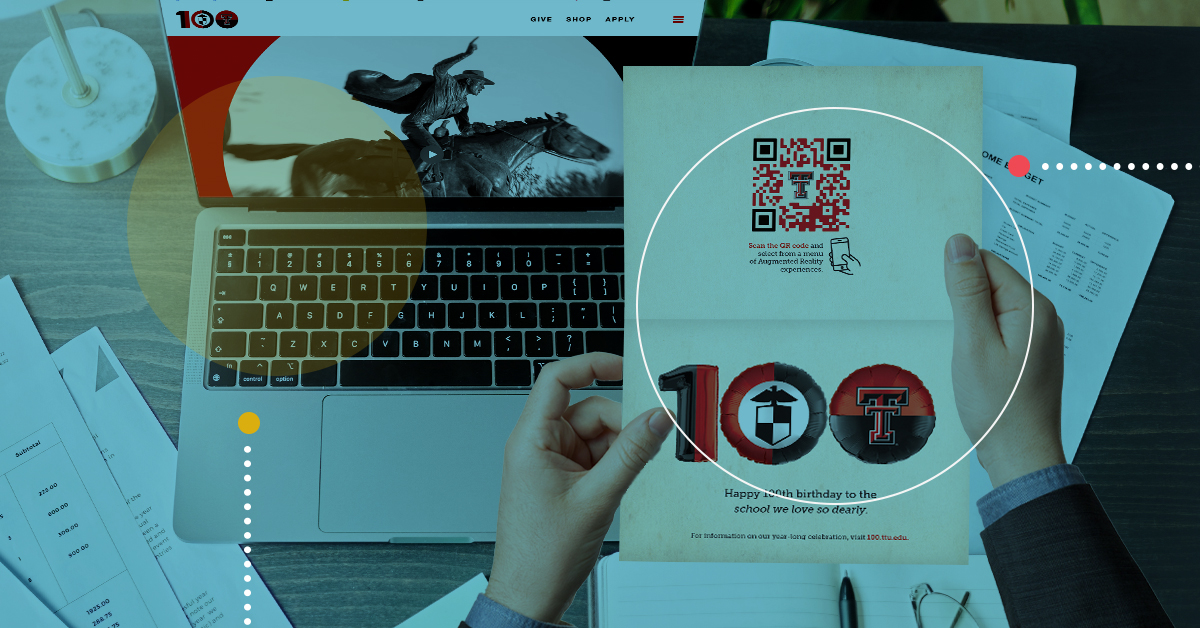
      Sharing the benefits and moments of being a community ripple the social sharing and interactions between institution, students, and alumni. By celebrating the moments of a university community, you humanize the institution and your values, building trust with prospective students and alumni through personalized interactions. Combining WebAR into your printed material with insights gleaned through data into student behaviors and motivations allows for innovative and fun ways to target your audience during holidays, graduations, reunions, and other memorable events. Personalized QR codes can transport messages from print to digital and share greetings, congratulations, and enhance storytelling through video, animation, 3D, and AR-immersive content. Here are examples of how Texas Tech University integrated WebAR into their direct mail to alumni.

    A comprehensive paid and multi-channel marketing strategy is essential for engaging both prospective students and alumni effectively. By leveraging digital channels, engaging content, targeted engagement strategies, and data-driven insights, institutions can cultivate meaningful connections, drive engagement, and elevate their brand presence in a competitive landscape. Contact a Marketing.com expert today to learn more about how we can help your school connect the dots and build deeper and wider engagement.