Author: Andrea Golindano

  • Strategies for Increasing Engagement with University Audiences

    Strategies for Increasing Engagement with University Audiences

    Implementing a robust paid and multi-channel strategy is pivotal for engaging both prospective students and alumni effectively. Marketing strategies can be leveraged to drive engagement, foster relationships, and elevate brand presence. A well-crafted multi-channel marketing strategy serves as a strong recruitment tool, facilitator of quick dissemination and announcements, and drives community-building efforts. By addressing the interests of both students and alumni, institutions can cultivate meaningful connections and foster engagement.

    Engaging students and alumni across various channels, such as paid adsdirect mail, and social media, maximizes opportunities for enrollment and alumni engagement. Consistent communication is key, with experts recommending between 7 and 12 touchpoints to effectively engage prospects. Distributing valuable and relevant content through blog posts, infographics, videos, and direct mail attracts and engages a diverse audience. Engaging content, such as student and alumni success stories, case studies, and testimonials, serves as compelling proof of an institution’s excellence and value proposition. Hosting giveaways, competitions, and scholarship programs further enhances engagement and attracts attention from target audiences.

    Digital channels offer a powerful platform for driving engagement through highlighting educational impact and providing valuable career resources. Paid advertising on social media platforms offers unparalleled reach and targeting capabilities. Active engagement on social media profiles is essential to maintain audience interest and prevent attrition to competing universities. By leveraging these platforms, both organically and through paid media, universities can bridge communication gaps and demonstrate the value their education offers.

    Personalization plays a crucial role in tailoring communications to individual preferences and interests, thereby enhancing engagement and resonance. Leveraging personal interests and demographics, institutions can deliver tailored messages to potential students, current students, alumni, and other key stakeholders. Paid advertisements are significantly effective on social media platforms. Using the user data available, ads are able to offer precise targeting applying diverse and detailed user information to facilitate the delivery of ads to highly relevant audiences. These details, often inaccessible through organic marketing efforts, pull personal interests and demographics into the marketing mix that organic marketing struggles to access.

    A study by HubSpot revealed that targeted advertising can result in a 74% increase in conversion rates, underscoring the impact of personalized messaging facilitated by social media’s data-rich environment. By harnessing this wealth of information, institutions can craft campaigns that resonate with specific audience segments (prospective students, students, alumni, donors) thus driving engagement. This targeting not only enhances the efficiency of marketing efforts, but also maximizes ROI making paid ads an indispensable tool for businesses looking to reach their target audience effectively on social media.

    Alumni, as an institution’s largest constituency, require targeted engagement strategies to foster meaningful connections. Creating a culture of giving that springs from involvement and not obligation, is key to driving engagement. It can be tempting, in the face of stagnant enrollment and rising costs, to make every alumnus communication about donations and giving. Your responsibility is to create a campus environment that prioritizes excellence and improvement; there is rich potential in your graduate population that quite literally walked the halls experiencing the campus environment that was created. One reason for low rates of alumni engagement may lie in the perception that every outreach is just another ask. The result is that your alumni communications are ignored. Non-monetary engagement opportunities, such as game watch parties and alumni networking events, strengthen ties to the alma mater. Personalization is paramount, with tailored communications ensuring relevance and resonance with individual experiences and aspirations. Applying these techniques add value to your alumni, which in turn, foster engagement, and meaningful connections with your institution.

    It’s imperative to seize the advantages of a multi-channel marketing strategy that applies personalized data to paid ads, social media, and direct mail to deepen existing relationships and further the engagement with your students and alumni. Here are three tips to foster an engaging environment by applying personalized data for a unique experience:

    1. Use Your Data to Greater Effect
      The ability to properly target your message based on specific information gives you incredible power to craft tailored communications that get read. Utilizing demographic information, income, major and field of study, extracurricular activities and clubs, you can keep your messaging fresh and personal as well as share content that you know your audience will find interesting. The insights you can glean from the data can help you create stronger, more impactful relationships.
    1. Integrate a Multi-Channel Marketing Approach
      Higher education institutions are beginning to recognize the cost savings and wider visibility that occurs when you present consistent messaging across marketing channels. Social media that flows into personalized direct mail communications with digital integrations and augmented reality experiences allow you to create an environment of engagement. Utilizing custom splash pages and display videos, you receive detailed analytics on each click and scan, thus refining the campaign and marketing efforts in greater detail. Applying the data obtained to retargeting opportunities allows universities to cater messaging based on location, interests, and past interactions with your institution. The goal is to drive fuller experiences that cause further engagements with your university.
    1. Combine Digital and Print Strategies to Connect
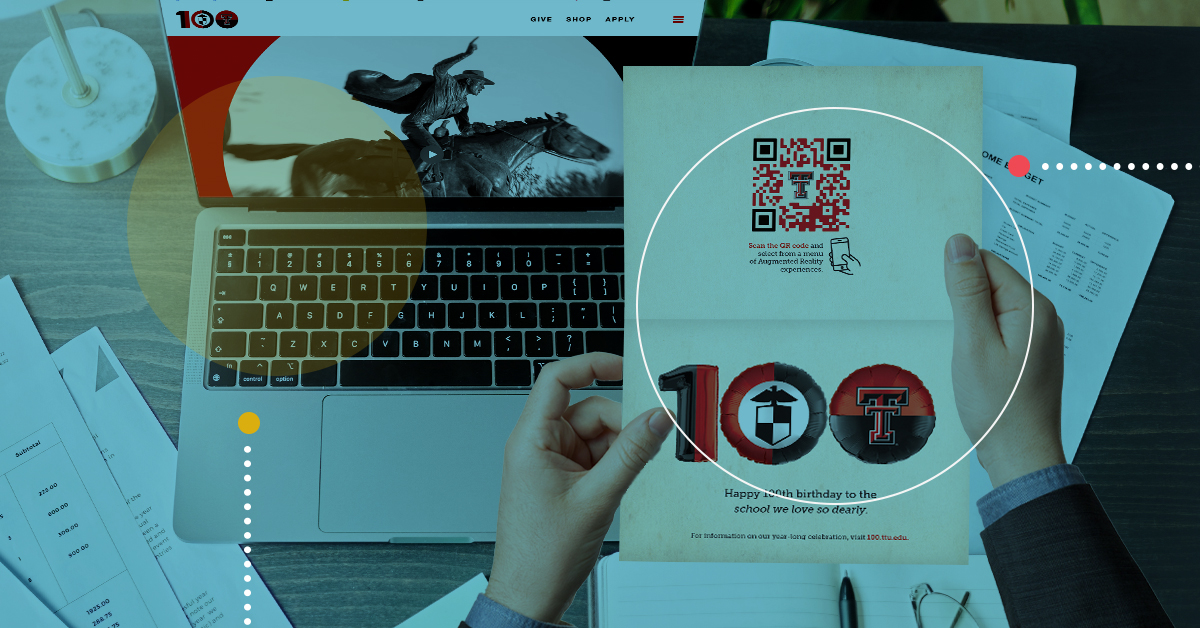
      Sharing the benefits and moments of being a community ripple the social sharing and interactions between institution, students, and alumni. By celebrating the moments of a university community, you humanize the institution and your values, building trust with prospective students and alumni through personalized interactions. Combining WebAR into your printed material with insights gleaned through data into student behaviors and motivations allows for innovative and fun ways to target your audience during holidays, graduations, reunions, and other memorable events. Personalized QR codes can transport messages from print to digital and share greetings, congratulations, and enhance storytelling through video, animation, 3D, and AR-immersive content. Here are examples of how Texas Tech University integrated WebAR into their direct mail to alumni.

    A comprehensive paid and multi-channel marketing strategy is essential for engaging both prospective students and alumni effectively. By leveraging digital channels, engaging content, targeted engagement strategies, and data-driven insights, institutions can cultivate meaningful connections, drive engagement, and elevate their brand presence in a competitive landscape. Contact a Marketing.com expert today to learn more about how we can help your school connect the dots and build deeper and wider engagement. 

  • Campus Signage & ADA Compliance

    Campus Signage & ADA Compliance

    You have a responsibility to make your campus ADA-compliant. The Americans with Disability Act (ADA) has strict requirements for keeping your entrances and exits, common use areas, classrooms, restrooms, and other areas of your property accessible to all. ADA-compliant signage plays an important role in helping students and visitors with disabilities to navigate across your campus and throughout your buildings. The design, fabrication, and placement of your signs sends a message of caring and concern for the safety and comfort of visually impaired individuals on your campus and demonstrates a commitment to creating a more inclusive community for all. 

    ADA signage should be welcoming and at every turn reveal the importance you place on guiding everyone comfortably and clearly on school grounds and in buildings. These signs can be innovative while also being compliant, will simplify navigation improve access, and create a positive impression of your school throughout your campus.

    Types of ADA-Compliant Signage

    ADA requirements apply to both exterior and interior signage, although exterior signs that are not located at door spaces do not have to be tactile, but must meet the visual stipulations of the act. Tactile signs must have raised characters that are repeated in Grade 2 braille, which uses the same characters as standard braille but include characters for common words and letter combinations. The technical standards for braille characters address depth, height and proportions, character spacing, and other elements of tactile signage. Tactile signage must include non-glare finish and high color contrast to meet the requirements under the ADA.

    Sign placement is also regulated under the ADA, and is uniform for all tactile signs to make them easy to find, reach, and read. They must be located at a height of between 48 inches to 60 inches beside or on doors and placed beyond the arc of any door swing.

    The most common uses for ADA signage across your campus must include:

    • Designations of Permanent Rooms and Spaces – ADA-compliant signs are required to identify any space deemed permanent under the ADA, which is an area that will serve the same function for more than 7 days. The signage must provide names and other information that will help identify the space. Common permanent rooms and spaces on your campus include cafeterias, libraries, classrooms, restrooms, offices, and conference rooms.
    • Directional ADA Signage – Signs that guide the flow of people on college campuses and prevent people from getting lost, confused, and frustrated when trying to find their way around must meet ADA visual requirements, but are not required to be tactile. If your buildings have inaccessible entrances, directional signage must incorporate international standards of accessibility (ISA) to assist individuals with finding accessible entrances and exits.
    • Informational ADA Signage – As is the case with your directional ADA signs, signage that includes instructions, rules of conduct, hours of operation, and other useful content must adhere to visual ADA requirements but do not have to be tactile. This applies even to signs that provide information located near permanent spaces. In such cases, ADA-required braille information must be used to identify the space, but all other content need only be visually approved content.
    • Means of Egress ADA Signage – Signs that identify entrances and exits at stairway doors, along public exit passages, and at building exits must be both tactile and meet visual requirements. In the case when both visual signage and tactile signage are used, as is the case with the familiar, brightly lit ‘Exit’ signs positioned above doors, the corresponding tactile information is posted on a separate sign that must meet ADA requirements.

    Types of Direct Mail Envelopes


    • Building Nameplate

    • Room Number ID

    • Classroom Name Plate

    • Elevator and Stair ID

    • Room ID

    • Directory Signage

    • Bathroom Signage

    • California Restroom Signage

    • Accessibility Signage

    Use this checklist to help meet ADA sign requirements on your campus and ensure that students, faculty, and staff can navigate campus grounds with confidence.


    • All interior wayfinding signage should include Grade 2 braille and be located near the door handle or latch

    • If the space will be in use for a period of more than seven days, ADA signage is required

    • All interior wayfinding signage should consist of contrasting colors and images and text should be in large, easily read fonts

    • ADA signage must be located directly next to what it is meant to describe

    • Use symbols that match international standards of accessibility (ISA) to avoid language confusion

    • Use illumination so that signage stands out any time of day and in any weather

    • Install tactile signs (both exterior and interior) to identify permanent rooms and spaces, entrances and exits for stairways and passageways, and elevator controls and emergency communication

    • Digital screens must be non-glare and display a 70% contrast between background and screen messaging

    • Mounted digital screens cannot extend more than four inches from a wall and must be mounted between 27-80 inches

    • Numeric keypads must be in sequence and have a raised dot on the #5 key

    When your ADA campus signage strategy is done right, everyone who arrives at your school gets the information they need to find their way around and feel comfortable everywhere they go. Contact a Marketing.com higher education ADA signage expert today to learn more about how we can help your school connect the dots and create a welcoming campus for all.  

  • SEO For Healthcare: Developing Effective Strategies in a Regulated Industry

    SEO For Healthcare: Developing Effective Strategies in a Regulated Industry

    Marketing healthcare services and products in the ever-evolving environment of patient data protection regulations requires healthcare SEO strategies that optimize keyword use and content creation without violating patient confidentiality. Although healthcare marketers may have to be a little more careful than their ‘unregulated’ peers when it comes to building SEO strategies and creating web content, they can focus on patient-centric approaches to providing answers and solutions when people are searching.

    Survival in the competitive healthcare space entails adopting marketing practices that provide relevancy and authority to keep current patients engaged, attract new ones, spread brand awareness and credibility across local communities, and be recognized as a trustworthy source of care and treatment.

    What is Healthcare Search Engine Optimization (SEO)

    Healthcare SEO is an effective tool that hospitals, clinics, healthcare providers, pharmaceutical firms, medical device manufacturers, health plans, and consumer brands use to achieve high rankings in search engine results pages (SERPs) and drive traffic to their websites. Healthcare SEO strategies include keyword research, content optimization, both internal and external link building, local SEO, and other proven traditional SEO practices.

    A well-planned SEO strategy ensures high organic search rankings when people are looking for relevant medical information and medical services, and, increasingly, the internet is the first place they look for answers. According to the U.S. Centers for Disease Control and Prevention National Center for Health Statistics, more than half of adults used the internet to look for health or medical information during July to December 2022, with higher prevalence among women than men.

    Three Types of Healthcare SEO      

    While many forms of healthcare SEO practices exist, they generally tend to fall into one of three categories that are equally important for increasing a website’s visibility and attracting visitors:

    • On-Page SEO concerns the items that appear on the website, such as short and long-tail keywords, images optimized with alt tags, and internal links to other web pages on the site.
    • Off-Page SEO involves improving page relevance with content that does not appear on the site, but that increases domain authority with backlinks to reputable sites, influencer mentions, and guest blogging on other sites.
    • Technical SEO represents all the inner workings of a website that occur out of sight but play a vital role when optimized to align with search engine guidelines. This form of SEO uses title tags, meta descriptions and headers and influences crawling, indexing, user-friendliness, and site speed.

    Why is Healthcare SEO Important?

    In an increasingly digital world, healthcare websites are where hospitals, clinics, and other healthcare professionals connect with patients and visitors. A sound SEO strategy and well-optimized website helps people discover and explore health services, ask questions and schedule appointments, and identify nearby hospitals and offices. It’s where these organizations can build trust and provide patients with information to make informed decisions along any stage of their healthcare journey. According to Press Ganey, 56% of patients will consult 3 different online sources when researching a doctor and Pew Research found that 66% of internet users have looked online for information about a specific disease or medical problem.

    Here are five advantages to be enjoyed with an effective healthcare SEO strategy.

    1. Improved Patient Engagement and Education. Healthcare websites can be wonderful sources for reliable medical information that empowers patients to make educated choices and take a larger role in their healthcare treatment. A user-friendly site also increases the time staff can spend attending to patient care rather than handling calls for appointments or giving directions.
    2. More Patients and Customers. Healthcare providers that enjoy high search rankings attract the attention of people investigating medical services and expand outreach to a potential patients who want validation for healthcare choices. Local SEO practices are especially useful to target new audiences and establish local community credentials for local practitioners.
    3. Gain a Competitive Edge. Prominent rankings on search engines enhance perceptions of authority and relevancy for hospitals and healthcare providers in the minds of people searching the internet for solutions and increases the attention websites get. Outranking the competition confers credibility and superiority.
    4. Cost-Effective Marketing. A well-optimized website is an important tool in a healthcare marketers’ arsenal. With a firm grasp and understanding of the needs and intentions behind a patient’s search, SEO strategies can expertly target individuals seeking answers and create websites that increase conversion rates and deliver a high return on investment (ROI).
    5. Mobile-Friendly Accessibility. Creating a website that responds to the way people search for information on mobile devices improves search rankings and allows healthcare providers to increase online exposure. As more people look for information on smart phones and Google gives mobile-friendly websites greater visibility on SERPs, a website that is accessible on every type of screen and even optimized for voice search is a necessity.  

    Important Steps for Effective Healthcare SEO

    • Set Goals and Perform Healthcare SEO Needs Assessment – First step for developing a healthcare SEO strategy is determining what your SEO should accomplish. Is the goal to rank first for all branded keywords? Is increased website or single page traffic important? Are your looking to collect email addresses for newsletters or subscriptions? Are you after new patients or looking to retain the ones you have? The clearer the goal, the more targeted the SEO strategy becomes. Also take a look at your website’s current performance and identify keyword gaps and pages that are not linked to any other page of your site (orphan pages) that influence the user’s website experience.
    • Set Up Google Analytics, Google Search Console and Google Tag Manager – Use these tools to gain valuable data for tracking performance metrics and enhance your understanding of what is working and where improvements are needed. They enable your business or organization to create precision SEO strategies that drive high placement on SERPs. Google Analytics offers in-depth insights into website visitor behavior in order to improve the impact of focused content and the user experience. The Google Search Console provides valuable information about the keywords most frequently used by the audience you want to attract and Google Tag Manager makes it easier to manage and deploy tracking tags for conversion tracking, site analytics, and more.
    • Make Site Secure – To protect against possible patient health information breaches and safeguard sensitive medical information, it’s vital that you prioritize website security. Secure your site with HTTPS by purchasing a Secure Sockets Layer (SSL) certificate so that patients can only access personal information online through a patient portal. Secure websites also factor into Google search engine algorithms and can result in higher rankings.
    • Understand Your Primary Persona – Understanding your audience is vital for developing an SEO strategy that delivers value and gives your patient exactly the information they are looking for. You should delve into what is important to them and what are the pain points your website can alleviate. For healthcare organizations, it’s also important to know where their audience is along their information gathering journey. Looking at the qualities of existing patients and customers can help you project the characteristics you want in new ones.
    • Pinpoint Intent – Determining search intent is very important because it takes your understanding of your primary persona to another level by predicting why a person requires your medical services or information. There are four types of intent to consider:
      • Information intent aligns with the seeking out and gathering of knowledge to address a problem or assess qualifications. The best practice to satisfy information intent is through the creation of blogs, articles, and publications that spur high search rankings.
      • Navigational Intent occurs when patients know the webpage they want but not the web address. Strategic application of metatags and URLs and clean site architecture lead to better search ranking results.
      • Transactional Intent is when users have come to a decision and want to make a purchase, set an appointment, or carry out a specific action. Compelling SEO optimized product and service pages provide the sought after content in this instance.
      • Commercial Investigation Intent happens when patients and customers essentially kick the tires and research future purchases and treatment options, looking to find the best fit to meet their needs. Patient reviews, success stories, and physician qualifications make great content to increase rankings.
      • Resource Intent refers to the search for specific information found in medical reports, clinical trial databases, and medical libraries. Peer-reviewed articles and white papers make great content sources that establish authority and relevancy, and generate resource keywords that search engines find attractive.
    • Perform Targeted Keyword Research – The foundation of every healthcare SEO strategy starts with intensive keyword research to unearth the specific terms that people use when searching the internet for information on medical providers and services. The closer you can match keywords to topics of interest to the people you want to attract, the more relevant and valuable your content will be. You can perform a keyword gap analysis to compare your site to your competitors to find high ranking keywords they use for search terms.
    • Create High Quality Content – Consistently creating insightful and highly researched content helps healthcare providers carve out a special place within their medical fields and gives patients material they will find relevant to their query. Posting blogs, sharing articles, and producing educational resources on a constant basis on your website gives search engines fuel that propels websites to high search rankings. Content should seamlessly incorporate short and long-tail keywords on topics that establish experience, authority, and trustworthiness.
    • Optimize On-Page SEO – Give search engines relevant keywords blended into compelling content and add elements such meta tags, headings, and URL to help them understand the relevance and importance of the information on a webpage. Use Alt tags to describe pictures and graphics, use H1 through H6 tags to show page hierarchy, and include keywords in metatags and header tags.
    • Build Backlink Quality – Reach out to reputable and respected sources in the healthcare community to develop a rich, impressive backlink profile. Pursue collaborations with experts, explore guest blogging posts and actively participate in medical forums on other established websites. Your association with these sites through backlinks lends your site a level of authority and credibility. You can perform backlink analytics to look at backlinks on competitor webpages and backlink gaps to see which respected websites link to your competitors but not you. You can also establish authority providing quotes to news outlets through Help A Reporter Out (HARO) found at helpareporter.com.
    • Amplify Local SEO – If you’re looking to draw patients and customers from a local community, local SEO is a must to increase visibility with local search results. Local search results that provide name, address, phone number, hours of operation, and maps and directions provide valuable information to grow your business in your local market. Local SEO strategy integrates location-specific keywords and listings likes Google My Business or Bing Places and can be automatically updated with store openings and holiday hours with a business listing management service.
    • Deploy Mobile-Friendly Design – This was mentioned before, but the importance of having a mobile-friendly website cannot be overemphasized. Each year more people are using their smart phones to research healthcare providers and seek answers to medical questions. The user experience must  be seamless regardless of device or screen size. The weight Google places on mobile-friendly websites in their algorithms makes it imperative to align the website with user search and research preferences.
    • Emphasize User Site Experience – A frustrated website visitor is a lost opportunity to establish a connection with potential patients and customers. Building a website with user-centric, easy to use site architecture, emphasizing site speed and crawling efficiencies, and making mobile capability a priority elevates the site’s visibility within search engines and addresses the key areas of usability, accessibility, and readability. Find a trusted web developer or work with a healthcare SEO marketing agency to guide you and provide support to optimize your site architecture.
    • Add Schema Markup – Schema markup helps search engines gain greater comprehension of website page content context. It is the syntax that can be added to a webpage’s theme or topic that reveals more details to encourage audiences to click on your search listing. Schema markup can exhibit valuable information like patient ratings, medical specialties, and medical conditions in the search result to give more information and increase visibility. Schema.org is a website that can offer a list of suggestions for adding effective schema markup to improve results.
    • Track and Monitor Results – It’s impossible to understand if your healthcare SEO strategy is working without using tools to measure and analyze results. Google Analytics can help you monitor site visits and provide visitor engagement overviews and Google Search Console shows you what terms people are using in their searches and should be tested for keyword effectiveness. These tools give you valuable information to improve keyword rankings and lead to higher search rankings.

    SEO strategies in the heavily regulated healthcare industry must take into account the restrictions healthcare organizations and businesses face when marketing services and products on their websites. While the foundation of effective search engine results relies on a deep knowledge and understanding of the keywords used and intentions behind them in search queries by patients, search engines also favor healthcare websites that offer compelling, useful content on websites optimized to enhance patient and visitor experiences.

  • How to Drive Direct Mail With Data Integrations Via API’s

    How to Drive Direct Mail With Data Integrations Via API’s

    Two factors influence the success of a direct mail campaign: design and data. Using APIs to integrate data from other internal sources can boost the effectiveness of each, allowing for fast and seamless communication between software programs and platforms.

    Direct mail campaign effectiveness is driven by the underlying data used, from who to mail to, and when, and with what promotion or offer that will resonate best with that audience. Developing data integrations utilizing APIs to automate and streamline direct mail campaigns from the look and personalization of mailers to the precise segmentation of data for improved campaign targeting is key. Leveraging APIs allows you to tie data together from a diverse set of sources, and use that data to improve campaign performance. API’s allow you to integrate with CRM, ecommerce, and variable print technologies to trigger customized messaging based on consumer behavior and in coordination with multi-channel outreach. Direct mail data integrations using APIs help track delivery, analyze results, and affordably scale direct mail campaigns based on trusted, actionable data.

    What is an API? 

    An application programming interface (API) is a set of programming code that enables data transmission between one software product and another over the internet using a set of definitions and protocols.

    How do APIs work? 

    An API acts as a go-between for a client (the application sending the request) and a server (the application sending the response). The client is the software that the user interacts with. The server performs backend logic to understand the request and performs the database operations it is asked to carry out. It then sends the resource (information that that server offers and provides) back to the client in a format the client software understands and can use. The client and server only share data that is necessary and neither of the two is ever exposed to the other, which offers better security and governance.  

    What are the benefits of APIs?

    APIs allow businesses to communicate and transfer data between the assorted technologies, computer systems, and applications that they use on a daily basis. APIs provide function and flexibility, and remove inefficient manual processes to reduce errors and let employees concentrate on more important tasks. The result is a more motivated and productive staff and better customer experiences.

    Benefits of Leveraging Data Integrations Using APIs for Direct Mail

    Direct mail campaigns that use APIs to integrate with CRM, ecommerce, and other marketing automation software make it easy to and efficient to segment data, personalize mailings, and track and measure direct mail campaigns. It turns what can be a time-consuming operation into one streamlined automated process that includes:

    • Importing segmented lists to boost engagement and improve response rates along every stage of your relationship with your prospect.
    • Sending “Triggered” mailings that go out to prospects who meet certain conditions based on behavior, purchases, or life events, like marriage or new home ownership.
    • Creating high-resolution PDF files of marketing mailers that can be personalized with variable data printing and shared with direct mail print shops for quick turn-arounds.
    • Integrating with postal services software for price savings and accurate tracking data.
    • Tracking campaign results to ensure delivery to targeted audiences, calculating return on investment (ROI), and conducting A/B testing to measure and adapt for greater success.

    Ways Data Integrations Using API’s Impact Direct Mail Campaigns

    Direct mail campaigns that integrate multiple sources of data using APIs are designed to enable software systems, rather than humans, to handle many of the mundane, repetitive tasks associated with putting together a direct mail campaign. They offer advantages to boost the effectiveness of direct mail for targeting audiences and tracking results that include:                          

    1. Personalized Content – Develop programs that dynamically generate personalized content for each recipient. This could include personalized product recommendations, exclusive offers, or targeted messages based on the recipient’s behavior and interests. Building a database of potential customers from multiple data sources, including lookalike models and personas, provides better targeting opportunities and continually grows audiences. This knowledge lets businesses personalize direct mail with more than names and addresses. It gives marketers information to craft personalized product offers, customize promotions by segments, and include personal URLs (PURLs) and QR codes to engage prospects with multi-channel marketing.        
    1. Segmentation and Targeting – Breaking down data according to prospect characteristics and patterns increases the likelihood of direct mail engagement and generating a response. There are four basic categories for segmenting data lists to customize direct mail effectiveness:
      • Behavioral Segmentation: Leverage data to segment your audience based on their behavior. This could include purchase history, website interactions, or responses to previous direct mail campaigns. This is valuable information because you can identify and trigger specific behaviors with targeted messages that are tailored to the experiences of your prospects.
      • Demographic: Integrate demographic data to create targeted mailing lists. This segmentation practice helps marketers develop messaging that appeals to specific income and age groups, as well as gender and education levels. This ensures that your direct mail campaigns are reaching the right audience with the right message.
      • Psychographic Targeting: Leverage data from third-party data sources to create audience segments based on factors such as personality, values, beliefs, and lifestyles. Marketers can tailor messaging based on an understanding of motivations and speak directly to your prospects individual desires and principles with greater effectiveness.
      • Geolocation: Integrate geolocation data to customize your direct mail based on the recipient’s location. This can be especially powerful for local promotions or events. Businesses deploying geolocation to compile effective mailing lists must choose between EDDM (Every Door Direct Mail), targeted, or saturation direct mail campaigns.
    1. Automation and Triggered Campaigns – Build and execute direct mail campaigns that go off without a hitch by using APIs to develop processes that seamlessly integrate with existing tech stacks. Schedule and perform campaigns that are planned and coordinated with a multi-channel marketing campaign or that are sent based on the actions of prospects. 
      • Event-Based Triggers: Set up triggers based on specific events or actions, such as celebrating a customer’s birthday or the anniversary of their first purchase. You can send coupons that follow-up on recent purchases or a special thank you with personalized offers. Trigger mailings based on website visits, abandoned shopping carts, and lapsed subscriptions.
      • Integration with Marketing Automation Platforms: Connect your direct mail system with marketing automation platforms to seamlessly incorporate direct mail into your broader marketing strategy. This allows for coordinated and synchronized campaigns across the various channels your audience trusts every day.
    •  
    1. Measurement and Analytics – Continually monitor campaign performance on customized dashboards that clearly let you see how your direct mail campaign is performing with. Include QR codes and PURLs to track engagements and conversions, and optimize data analytics to measure attribution.
      • APIs for Analytics Platforms: Integrate your direct mail data with analytics platforms to measure the impact of your campaigns. Track conversion rates, response rates, and other key metrics to refine your future campaigns.
      • A/B Testing Integration: Use APIs to integrate A/B testing capabilities into your direct mail campaigns. Test different elements such as messaging, design, or offers and analyze the results to optimize future mailings.

    Compliance and Data Security:     

     Guard against data breaches and stay in compliance with data-privacy and data-security regulations enacted to battle cyber-attacks and prioritize the protection of the consumer data you collect.

    • GDPR and Privacy Compliance: Ensure that your data integrations and API usage comply with data protection regulations such as HIPAA and GDPR. Implement secure protocols to protect customer data.
    • Permission Management API: Implement APIs for managing customer preferences and permissions, allowing recipients to opt in or out of direct mail communications easily.                               

    Using APIs to connect to multiple data sources gives you quick and easy integrations with leading ecommerce, CRM, and through-channel marketing platforms that flow segmented consumer data into your direct mail and simplify the entire campaign from start to finish. Contact a Marketing.com marketing expert today to learn more about how we can help your business connect the dots and integrate data into your direct mail for better campaign performance.